
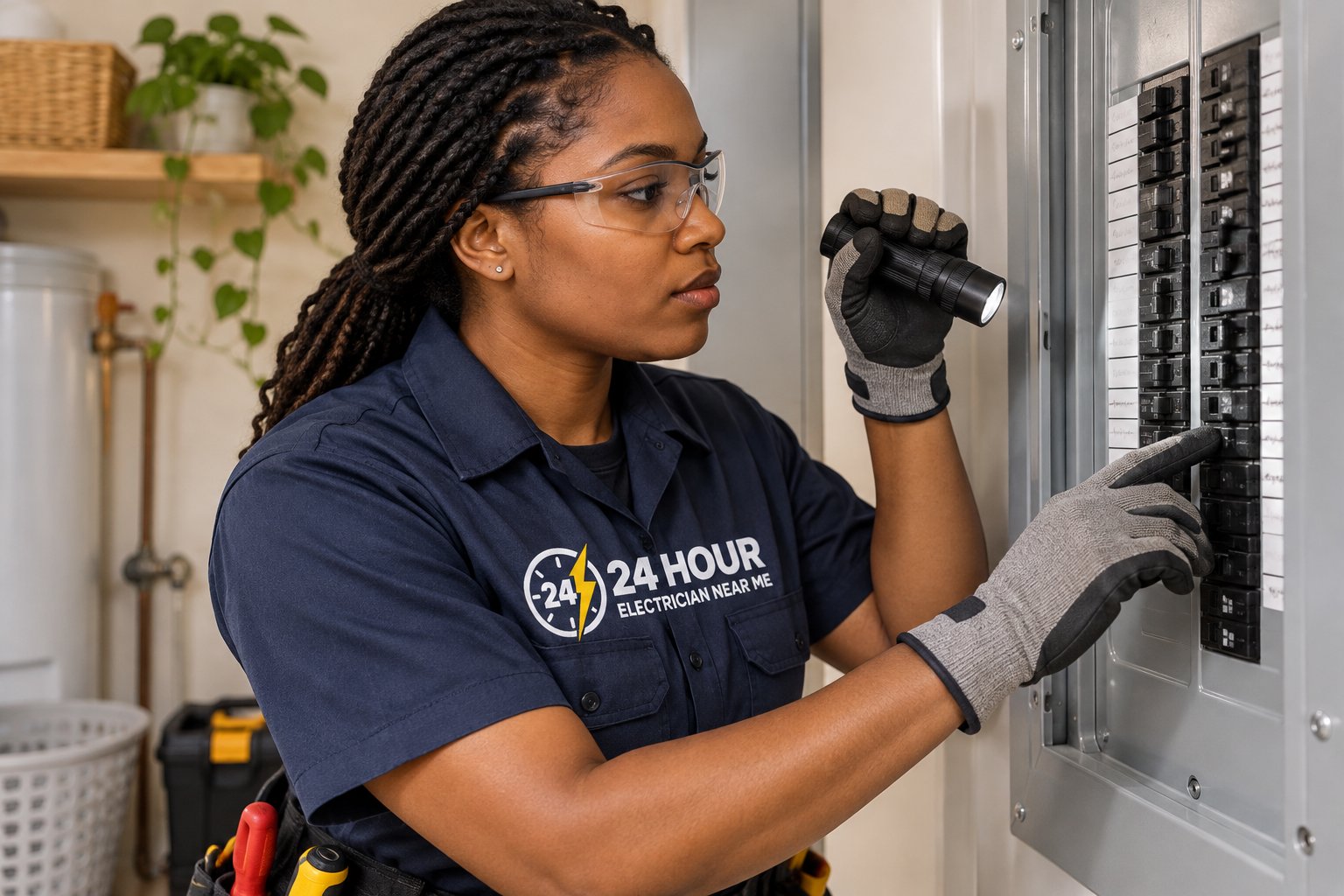
Know when to leave the panel alone.
Do not touch a panel, disconnect, breaker, receptacle or appliance when there is smoke, active arcing, fire, standing water, visible damage or an immediate threat to people. Move to a safe location and call 911 when emergency conditions exist. Keep people away from downed conductors and damaged exterior service equipment, and report utility equipment concerns through the utility's official channel.
Heat, a burning odor, buzzing, crackling, discoloration, melted material or repeated operation are warning signs that should not be managed through repeated resetting. Turn affected equipment off only when that can be done normally and safely without approaching the hazard. Do not remove the panel cover or touch exposed parts. A website cannot determine from a symptom whether equipment remains energized.
Fire, smoke, active arcing, downed lines, electrical contact or immediate danger: move away and call 911.

Heat, odor, water, impact, visible damage or repeated trips: stop using the affected equipment and request qualified evaluation.
No danger signs: document the circuit, loads, timing and recurrence without opening electrical equipment.
The U.S. Consumer Product Safety Commission describes fuses and circuit breakers as protective devices intended to stop current when it exceeds a safe level. CPSC also advises investigating why a breaker trips rather than simply resetting it. That is the operating principle of this page: the trip is evidence to understand, not an inconvenience to defeat.
Several causes can produce the same outward symptom.
A standard overcurrent breaker may operate because a circuit is overloaded, a connected product is malfunctioning, a conductor or connection has a fault, or the protective device itself requires evaluation. A ground-fault or arc-fault device can operate for different protective reasons. A main or feeder breaker affects a broader part of the property than one branch-circuit breaker. The handle position alone does not identify the root cause.
The service request should avoid declarations such as "bad breaker" unless a qualified assessment has established that result. Replacing a breaker without addressing a downstream problem can leave the underlying condition unresolved. Adding a larger breaker to stop trips is not an acceptable shortcut; protection must match the circuit and approved design. Customers should never select a rating based on appliance size or an internet chart.
Overload is a pattern, not a guess
An overload can occur when operating loads demand more current than the circuit is designed to carry. The most useful observation is which equipment was running and whether the trip follows a consistent combination. Space heaters, cooking equipment, hair-care appliances, portable air conditioners and other higher-demand products can reveal a pattern, but the electrician must verify the circuit and condition. Moving a load to another outlet without understanding the circuits may simply move the problem.
A fault can happen with one device or no obvious device
If operation follows one appliance, cord or tool, stop using that item and report the pattern. The product may require manufacturer service, replacement or electrical evaluation. If the circuit trips with everything apparently off, hidden loads, fixed equipment, wiring or the protective device may still be involved. Do not unplug hardwired equipment or open junction boxes to investigate.
The breaker can also require evaluation
Protective devices can be damaged, incompatible, improperly installed, subject to recall or unsuitable for the equipment they are protecting. Correct replacement requires panel identification, listing information, circuit verification and an assessment of why the device operated. Visual similarity is not proof that a breaker is approved for a particular panel.
Timing narrows the assessment without asking the customer to test energized parts.
Trips immediately
Report whether it operates as soon as the handle is moved, when a switch is used or when a specific device starts. Do not repeat the action to create the symptom.
Trips after several minutes
Record the loads operating and the approximate delay. Heat or increasing demand may be relevant, but only testing can establish the cause.
Trips only with one product
Stop using the product. Preserve its model information and describe the outlet or connection; the product and circuit may each need evaluation.
Trips during rain or moisture
Do not touch wet equipment or enter water. Identify exterior, garage, pool, landscape or damp-area loads from a safe place.
Trips unpredictably
Build a short log of dates, times, loads and weather. Intermittent conditions may not occur during the first visit.
Main or large feeder trips
Treat broad loss, heat, odor or repeated main operation as a priority assessment. Do not remove covers or attempt load testing yourself.
A helpful report uses observations, not a self-diagnosis. "The kitchen circuit opened twice when the toaster oven and kettle were operating" is more useful than "the breaker is weak." "The outdoor receptacles lost power after heavy rain" is better than assuming a ground fault at one location. The electrician can then plan tools, access and likely testing boundaries.
One trip after an unusual event and repeated trips during normal use are different histories. Both may deserve evaluation depending on the circumstances. Any associated heat, odor, sound, visible damage, shock or tingling raises the priority and changes the safety instructions.
"The breaker" may include more than standard overcurrent protection.
Test buttons are intended to check protective operation according to manufacturer instructions; they are not diagnostic tools for customers to use during an active problem. Labels and indicator sequences vary by product. The provider should use the exact manufacturer documentation and record the device model rather than applying one brand's interpretation to another.
A GFCI receptacle can protect additional outlets downstream, so the location without power may not contain the device that opened. Likewise, an AFCI or dual-function breaker can protect a circuit with many connected items. Mapping the circuit is part of a careful visit. Customers should not open boxes or panel covers to trace it.
| Device or condition | What the customer may observe | What the assessment must establish |
|---|---|---|
| Standard circuit breaker | A handle moves to an off or intermediate trip position and power is lost to a circuit. | Circuit identity, connected load, fault evidence, conductor and connection condition, device compatibility and reason for operation. |
| GFCI protection | A receptacle or breaker test/reset mechanism operates and downstream locations may lose power. | Protection layout, affected equipment, moisture or leakage context, wiring condition and device performance. |
| AFCI protection | An arc-fault breaker indicates a trip, sometimes with manufacturer-specific diagnostics. | Device instructions, circuit conditions, connected equipment, wiring and the meaning of any supported diagnostic indication. |
| Dual-function protection | One device provides more than one protective function and may offer an indicator. | Exact model, instructions, required protection and verified cause, not assumptions from indicator color alone. |
| Main or feeder breaker | A large area, panel or whole property loses power. | Load, downstream equipment, service or feeder condition, utility context and the safe coordination of any shutdown. |
One action should never become a cycle.
Some breaker designs move fully to OFF, while others rest in an intermediate position. CPSC guidance explains that the underlying problem should be eliminated before a breaker is reset. If there is any sign of damage, heat, water, odor, sound or uncertainty, leave the equipment alone and request help. Property-specific instructions from the utility, manufacturer, building management or emergency responders take priority.
If a safely accessible, undamaged breaker is reset under appropriate guidance and it operates again, stop. Repeated resets can re-energize a fault or failing product. Do not hold a handle in position, defeat a protective device, replace a fuse with a larger size, install an oversized breaker or use an improvised connection to restore power.
Tenants and employees may not be authorized to operate building electrical equipment. In condominiums, commercial buildings and managed properties, contact the responsible manager. Restricted electrical rooms are not customer work areas.
The same trip has different operational consequences.
Single-family home
Identify the rooms, outlets, lights and fixed equipment affected. Note recent appliance changes, renovation, storm conditions or water intrusion. The homeowner should provide safe access and avoid clearing stored items by leaning them against the panel. Children and pets should remain away from the work area.
Condominium
Determine whether the affected breaker is in the unit, a common electrical room or building equipment. Ask whether neighbors or common areas are affected. Management may need to grant access, identify ownership boundaries and authorize work. A unit owner should not enter a locked electrical room.
Rental or apartment
Notify the landlord or property manager except when an immediate emergency requires 911. Record the affected areas and any temporary instruction from management. The service provider should confirm who can authorize repairs, receive documentation and approve changes in scope.
Commercial space
Identify the interrupted operation: lighting, receptacles, refrigeration, kitchen equipment, access control, point-of-sale systems, machinery or tenant equipment. Provide an authorized facility contact and one person responsible for shutdown decisions. Production and customer areas may need to remain closed until the condition is understood.
Managed and specialized facilities
Life-safety systems, elevators, fire pumps, medical equipment, generators, industrial distribution and other specialized systems require verified capability and coordination. A general website request cannot promise that the provider is qualified for every system. Route outside-scope work to the appropriate qualified specialist.
Do not assume a breaker trip is isolated from the building event.
South Florida storms can combine utility interruption, wind damage, water intrusion and customer-owned equipment damage. If a breaker operates after flooding, roof leakage, impact or visible service damage, do not re-energize the affected area. Report downed lines and utility equipment concerns through official channels and follow emergency instructions.
Power returning after an outage can restart equipment. If a circuit or main breaker then operates, record the sequence and loads without repeating it. Commercial properties may need a controlled restart plan. An electrician can assess qualifying customer-owned equipment, but utility restoration, structural repair, water remediation and inspection can involve other parties.
Exterior circuits serving pools, docks, landscape equipment, gates, signs and outdoor receptacles have additional exposure. Keep away from wet equipment and standing water. Describe the affected area from a safe location and note whether rain was active when the condition occurred.
Assessment first, repair second, documentation last.
The visit should begin by confirming the reported pattern and safety conditions. The electrician can identify the circuit, review accessible equipment, evaluate connected loads and conduct appropriate testing within the agreed scope. The provider should explain when equipment must remain off, when additional access is required and when the condition belongs with the utility, appliance servicer, building manager or another specialist.
Possible outcomes include correcting a connection, repairing a circuit condition, replacing a compatible protective device, separating or reconfiguring loads through approved work, addressing a damaged device, recommending further investigation or finding that the reported condition could not be reproduced. The result should follow evidence; the page should not imply that every call ends with a new breaker.
A replacement breaker must be suitable for the panel and application. The scope may also involve required GFCI, AFCI or dual-function protection, labeling and permit considerations. Current local requirements and manufacturer instructions govern. No universal part number or code conclusion should be offered from a web form.
When the condition is intermittent
An intermittent trip may not occur during the appointment. The provider should document safe observations, available measurements, equipment reviewed and next steps. Monitoring or a follow-up under controlled conditions may be more responsible than guessing. The customer should understand what remains uncertain.
When the circuit is overloaded
The answer may involve changing use, adding a properly designed circuit, redistributing fixed loads or another verified solution. An extension cord is not a permanent wiring solution. The proposal should explain why the recommended work addresses the documented pattern.
Closeout record
The invoice or service report should identify the circuit or equipment, customer complaint, assessment, work performed, parts used, testing and unresolved items. If a permit, inspection, product repair, utility action or return visit remains, name the responsible party and restriction.
Restoring power is only one part of restoring operations.
A commercial breaker event can affect food safety, customer access, security, technology, ventilation or production. The business, not the electrician, makes operational and public-safety decisions. The facility contact should identify critical loads and equipment that must not restart automatically. Specialized equipment may require its manufacturer or service contractor.
Before the appointment, gather panel schedules, one-line information if available, maintenance records and the names of other trades recently working in the area. Do not open equipment to collect labels. Confirm loading-dock access, parking, escort rules, working hours and shutdown approval. For multi-tenant buildings, coordinate with the landlord or building engineer.
A temporary restoration plan must be designed and authorized; improvised cords, bypassed protection and undocumented breaker changes are not acceptable. If phased repair is proposed, the written scope should identify what remains out of service and the conditions for final completion.
Verify the contractor and the jurisdiction.
Permitting depends on scope and the authority for the property address. Broward County and the cities from Boca Raton to North Miami contain multiple municipal jurisdictions, so the county name alone does not identify the permitting office. A proposal should state who is responsible for required permits and inspections. Replacing a device during diagnostic service and modifying a circuit or panel may have different review requirements; the contractor should confirm the current rule with the correct authority.
Customers should obtain a clear written scope showing labor, parts, exclusions, permit responsibility, cleanup, warranty and change-order process. An urgent electrical problem should not be used to pressure a customer into unrelated work.
Capture facts without recreating the problem.
Do not create a trip for the appointment, remove a panel cover, hold a breaker on, move wiring or open a hardwired appliance. A photograph of the closed panel and written label can help prepare the visit, but identification must be verified on site.
Answers that preserve the diagnostic process.
Does a tripped breaker mean the breaker is bad?
No. It may be responding to overload, a fault, connected equipment or another circuit condition. The protective device itself is one possibility that requires evaluation.
Can I keep resetting it?
No. CPSC advises determining why a breaker trips rather than simply resetting it. Do not reset equipment with heat, water, odor, damage or other warning signs.
Can I replace it with a larger breaker?
No. Protection must match the circuit and approved design. An oversized device can leave wiring inadequately protected.
Why does it trip only when two appliances run?
The combined demand may be relevant, but circuit identity and condition must be verified. Record the equipment and timing rather than repeating the test.
Why does my GFCI breaker trip?
Several equipment, moisture and wiring conditions are possible. The exact device and circuit need assessment; an indicator is not a complete diagnosis.
Can you quote a breaker replacement from a photo?
A photo may help identify the panel, but compatibility, cause, access, circuit condition and scope must be confirmed.
Is this emergency dispatch?
Do you guarantee same-day repair?
No. Availability, safe access, parts, scope, permits and other dependencies must be confirmed before scheduling.
Official references
For "A reset is not a repair.", a phone call comes first. Describe the circuit, the breaker or the equipment, and we will talk through the safe next steps and whether the job needs an on-site look.
Related pages
- Home: Electrical repair and installation for homes and businesses in Broward County and the cities from Boca Raton to North Miami. Quotes by phone, clear steps, safety first.
- AC Electrical Work: Electrical work for air conditioners: disconnects, whips and breaker sizing at outdoor units, and why the electrician and AC contractor coordinate.
- Guest Suite Power: Electrical planning for a converted garage, in-law suite or detached unit: feeder size, subpanel choices, load calculations, metering and inspection steps.
- Aluminum Wiring: Aluminum branch wiring from the 1960s and 1970s: why it needs attention, repair options from connectors to partial replacement, and how a technician decides.
- Arc-Fault Breakers: Where arc-fault breakers apply, why they trip on certain loads, and how a technician adds arc-fault protection to existing circuits in older homes.
- Bathroom Fans: Wiring and replacing bathroom exhaust fans, fan and light combinations, humidity-sensing controls and the electrical details around venting.