
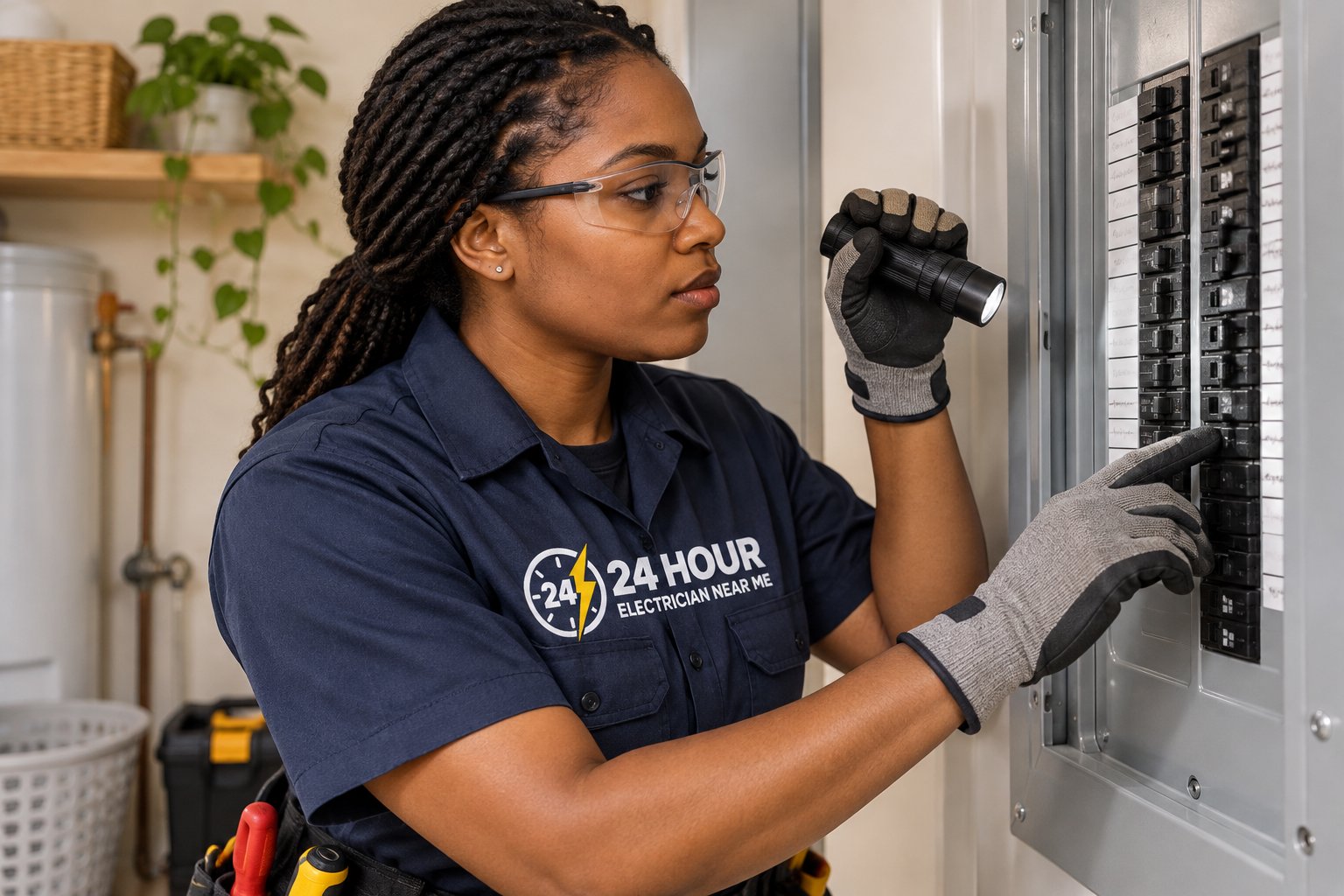
How a breaker is designed to behave
A circuit breaker is a protective switch. It sits between the panel's bus bar and the wire of a circuit, and its job is to open that connection when the current becomes dangerous for the wire. It does this in two ways. A thermal element, usually a bimetal strip, bends as it heats under a sustained overload and eventually releases the latch. A magnetic element reacts almost instantly to a very large surge of current, such as a short circuit, and releases the latch immediately.
When a breaker trips, the handle moves to a middle or off position. To restore power, you push the handle all the way to off to re-cock the mechanism, then back to on. If the cause of the trip has gone away, the breaker holds. If the cause is still there, the breaker trips again, sometimes the moment you reach the on position, and that is exactly what protective devices are supposed to do.
So a breaker that will not reset is not necessarily broken. Often it is telling you that something on the circuit is still wrong. The task is to work out whether the problem is on the circuit, on the breaker or in the panel, and the three have very different consequences. This page explains how to separate them and what is safe to do.

Hard faults: a short circuit or ground fault that is still there
The most serious reason for a breaker that will not reset is a hard fault. A short circuit occurs when a hot conductor touches a neutral or another hot conductor, producing a huge surge of current. A ground fault occurs when a hot conductor touches a grounded surface. In both cases the magnetic element trips the breaker almost instantly, and if the fault is still present it trips again every time.
Hard faults come from damaged wire insulation, a nail or screw driven through a cable, a loose wire touching the inside of a box, a failed fixture or receptacle, a damaged cord, a failed appliance, water in a box or a rodent that has chewed a wire. They can also develop at connections that have burned and carbonized.
A breaker that trips instantly with a pop or a bang when you move it to on, especially with nothing plugged in and every switch off, strongly suggests a hard fault in the wiring or a device on that circuit. Leave it off. Resetting it again and again risks arcing at the fault and heat at the breaker. The page on a breaker that keeps tripping covers repeating overloads, which is a different situation from a breaker that will not hold at all.
Overloads and appliances that keep the circuit tripped
Not every non-resetting breaker means damaged wiring. A circuit may carry a load that is too great, or an appliance that is still switched on or plugged in may be drawing excessive current as soon as power returns. A failed motor, a shorted heating element or a compressor that cannot start can all hold a breaker in a repeating trip cycle.
The safe way to test this is to remove the load. With the breaker off, switch off or unplug everything on that circuit: lamps, chargers, power strips, appliances and any device in the rooms the breaker serves. Then try one reset, standing to the side. If the breaker holds, plug items back in one at a time and watch for the one that trips it. That item is faulty or too heavy for the circuit.
If the breaker will not hold even with every load removed, the fault is likely in the fixed wiring, a device in the wall or the breaker itself. That is the point at which to stop and call. Do not go looking for the fault by removing outlet covers or opening junction boxes; those steps put you in contact with conductors that may be live from another source or damaged.
A worn or failed breaker
Breakers are mechanical devices with springs, latches and heat-sensitive parts, and they do not last forever. A breaker that has tripped many times, has been exposed to high heat, humidity, salt air or a significant fault, or is simply old may no longer latch properly. Signs include a handle that feels loose or mushy, a breaker that will not stay on even with every load removed, a breaker that is warm or discolored, buzzing, or a handle that will not go all the way to off.
Salt air and humidity are rough on panels in coastal South Florida. Corrosion on the breaker contacts and the bus bar raises resistance, and a breaker running hot can trip at lower currents than it should. In some older brands the breakers are known to be unreliable and may fail to trip when they should, which is the more dangerous failure. The pages on Federal Pacific panels and Zinsco and older panel brands explain those concerns.
A failed breaker is replaced with an identical type that fits the panel and is listed for it. Using the wrong brand or type in a panel is unsafe. The technician confirms the replacement matches the panel and the circuit, and checks the bus bar contact point for damage while the breaker is out.
Types of breakers and why the type matters
Several breaker types look similar and behave differently, and the one that will not reset may be a different kind. A standard breaker senses overload and short circuit. A GFCI breaker also senses leakage to ground, protecting against shock. An arc-fault breaker detects the signature of arcing in wiring and trips even when the current is modest. A dual-function breaker does both. Each has a test button, and each has its own reasons for tripping.
A GFCI or arc-fault breaker that will not reset can be tripping because of a fault that an ordinary breaker would have tolerated. For example, a small ground leak from damp wiring, a neutral shared between circuits or a damaged cord may trip a GFCI or arc-fault breaker repeatedly while an ordinary breaker would hold. That is the device doing its job. The pages on GFCI breakers versus outlets and AFCI breakers explained go into how each type works.
Double-pole breakers feed 240-volt loads such as air conditioners, dryers and ranges, and two handles are tied together. If one half trips, both go off. A double-pole breaker that will not reset could point to the appliance, the cable or the breaker, and it deserves the same caution as any other.
Safe steps you can take
Some steps are reasonable for a homeowner; others are not. The distinction is whether you need to touch conductors or defeat a safety device. Standing at the panel, with a dry floor and no standing water, and operating the handle is acceptable. Removing the panel cover is not.
Before trying anything, look and listen. If there is any smoke, burning smell, scorch marks, buzzing, hot panel door or sign of water at the panel, do not touch it. Leave the area and call 911 for smoke or fire, or an electrician for the other signs.
- With the area dry and clear, identify the breaker that tripped, using the panel labels or the dead rooms.
- Switch off or unplug everything on that circuit, including lamps, strips, chargers and appliances.
- Push the handle firmly to off, wait a moment, then push it to on. Stand to the side and look away from the panel.
- If it holds, reconnect items one at a time and watch for the one that trips it.
- If it trips immediately or will not latch, leave it off, and do not try again.
- Note the breaker position, what was running and what you heard, and call a qualified technician.
Things you must never do
Never hold the handle in the on position by force, tape it down or wedge it. A breaker that is being held on cannot protect the wire, and a fault can then heat the wiring in the wall until it ignites a fire. Never replace a breaker with a larger one to stop the tripping. The breaker size is chosen to protect the wire, and a bigger breaker lets the wire overheat before it trips.
Never open the panel cover to look inside, loosen terminal screws or move wires. The main lugs at the top of a panel are energized even with the main breaker off, and the interior is a hazardous place. Never use a screwdriver to probe, and never reach into a panel that is wet or in a wet location.
Never swap a non-resetting breaker with another from a different circuit to see what happens. That can put a heavier breaker on lighter wire. And never ignore a breaker that is hot, buzzing or discolored simply because it is still on. Those are signs of an overheated connection, which can progress to a fire without further warning.
What a technician does to find the cause
The technician first inspects the panel for heat, corrosion and damage, and tests the breaker, then disconnects the circuit from the breaker to see whether the breaker will hold with no load. If it holds, the fault lies on the circuit, and the technician tests the conductors for insulation breakdown and short circuits using an insulation tester or similar instruments. If it still will not hold, the breaker or its connection to the bus is the suspect.
On the circuit, the technician works outward from the panel, isolating sections until the fault is found. Typical findings include a damaged cable, a burned receptacle, a loose neutral, water in a box or a fault in a fixture or appliance. Repair is usually local: replacing the damaged device, section of cable or connection, then restoring the circuit and verifying that the breaker holds under load.
Pricing is only given by phone, and bigger jobs need an on-site visit first. A service call charge applies, explained before dispatch. For broader information about breaker and panel repair, see circuit breaker repair and electrical panel repair.
When to call and what to have ready
Call as soon as a breaker will not reset, particularly if the loss of power affects a refrigerator, a freezer, medical equipment, an air conditioner on a hot day or a sump or well pump. Call urgently if the breaker is hot, buzzing, discolored, or the panel smells of burning. If there is smoke, fire or sparks, leave and call 911 first.
For the call, have your address, which breaker or area is affected, what was running when it tripped, what you have already tried, and whether the panel has been serviced in the past. A photograph of the panel label or the breaker brand helps, taken from outside the cover without opening it.
The 24-hour name describes the service concept, and availability is confirmed on the call. When you are ready, call, explain what the breaker is doing and let the dispatcher help you decide how soon a technician should come. If the outage affects food storage or medical needs, say so, and ask what you can do to protect them in the meantime.
Questions people ask
Why will my breaker not stay on?
Either a fault on the circuit is still present, such as a short circuit or ground fault, an appliance is drawing too much, or the breaker has worn out and cannot latch. Removing every load from the circuit and trying one reset helps separate those cases. If it still will not hold, stop and call.
Is it okay to keep trying to reset it?
No. One careful attempt after removing loads is reasonable. Repeated attempts against a fault cause arcing and heat at the fault and at the breaker. If it trips again immediately, leave it off and have a qualified technician find the cause.
Can I put in a bigger breaker to fix it?
Never. The breaker size is set to protect the wire in the wall, and a larger breaker lets the wire overheat before it trips. That is a fire hazard. The correct fix is to find why the original breaker tripped and repair the cause.
How do I know if the breaker itself is bad?
Signs include a loose or mushy handle, a breaker that will not latch with all loads removed, heat, buzzing or discoloration. Only testing can confirm it, because the same behavior can come from a fault on the circuit. A technician can test both and replace the breaker if needed.
Is a double-pole breaker different?
A double-pole breaker feeds 240-volt loads, such as air conditioners, dryers and ranges, and its two handles trip together. The safety rules are the same, but the cause may be the appliance, the cable or the breaker. Have it checked if it will not reset.
Will I lose food while it is off?
It depends on how long power is out. Keep refrigerator and freezer doors closed, and tell the dispatcher that food or medicine storage is affected. A technician can prioritize the circuit, and in some cases a temporary arrangement may be possible once the fault is understood.
Dealing with "A Breaker That Will Not Reset"? Tell us where in the building it happens and what changed before it started. We will say what the electrician would check and how the visit charge is explained.
Related pages
- Circuit Breaker Troubleshooting: A safety-first South Florida guide to recurring breaker trips, circuit problems, breaker evaluation and documented electrical repair.
- Breaker Tripping: A breaker that keeps tripping is telling you something. Learn the difference between overload, short circuit and ground fault, and why resetting is risky.
- Panel Repair: Guide to electrical panel repair, replacement and capacity upgrades in South Florida: what an evaluation covers, permits and what to prepare before a visit.
- AFCI Breakers: How arc-fault circuit interrupter breakers detect dangerous arcing, why they sometimes trip for no obvious reason, and what a technician checks when they do.
- Federal Pacific Panels: History and concerns about Federal Pacific Stab-Lok panels in older South Florida homes, how to recognize one and what owners can do next.
- Bulbs Burning Out: Bulbs that keep burning out usually point to heat, voltage, loose sockets or a mismatched dimmer. Learn the causes and what to check before replacing again.
What to write down so the cause is found faster
When a breaker refuses to reset, the details you can gather without opening anything are surprisingly useful. Note which breaker it is, and what it controls according to the panel label, keeping in mind that labels are sometimes wrong. Write down what was running when it tripped, whether anything popped, buzzed, or smelled, and whether the breaker handle moves loosely, feels spongy, or snaps back immediately. Also note whether the same circuit tripped earlier in the week, since a pattern points to a different cause than a one time event.
Next, record what else stopped working. If only one room lost power, the problem is probably on that circuit. If several seemingly unrelated areas are out, the issue could involve a shared neutral or a larger device. Check whether other breakers are tripped or in a middle position. Look at the lights and outlets with only your eyes, and do not unplug devices if it means touching damaged cords or wet surfaces. If anything is hot or discolored, keep away from it and tell the person you speak with. Honest answers about the building help the visit fit the actual situation.
Share this information when you call. A clear description lets the person scheduling the visit decide what to bring and how urgent the situation sounds. Do not keep forcing the handle, tape it, or replace it yourself with a bigger breaker, because that removes the very protection the breaker provides. Availability is confirmed by phone, and the scope and any quote are explained before work begins so you know what the visit will involve and what the options are afterward. Bring up any concern, even a small one, so it can be addressed at the same time.
After the repair: confirming the circuit is truly sound
Once a cause has been found and corrected, the work is not finished until the circuit is shown to behave properly. The technician will usually restore power and observe the breaker under normal use, testing outlets and switches along the circuit. Where appropriate, protective devices are tested using their built in test buttons or a tester. If the cause was an overloaded circuit, the explanation should include what loads are reasonable on it going forward, so you do not simply recreate the same problem the next time the house is busy.
Ask what was changed and why, in plain words. If a breaker was replaced, you should know whether the old one was worn, damaged, or mismatched to the panel. If a connection was tightened or a section of wire repaired, you should know where. If the technician recommends further work, such as adding a circuit or updating a panel, ask for the reasoning and the options, including the option of doing nothing for now and the risks of that choice. A good answer is specific and does not rush you.
Keep a record of the visit. Take a photo of the updated panel label, and write a note of the date and the work done. If a permit was needed, keep the paperwork. Over the next days, watch for warm covers, flickering, or odd smells, and call back if the symptoms return. A breaker that trips again soon after a repair is a signal that something has not been fully resolved, and it deserves a prompt follow up rather than another round of resetting. The more clearly the situation is described, the better the preparation can be.