
The problem an AFCI breaker is built to catch
An ordinary circuit breaker protects against two events: an overload, where too much current flows for too long, and a short circuit, where current surges because the conductors touch. Both produce a large flow of current. A third kind of fault does not. An electrical arc is a small, erratic discharge that jumps across a gap, such as a damaged conductor, a loose terminal or a nail through a cable. The arc can generate intense local heat and ignite surrounding material while drawing less current than a toaster.
Because the total current stays below the breaker rating, a standard breaker never trips. A cable with a slowly failing connection or a crushed section behind furniture can sit there arcing quietly. This is why arc faults are a recognized cause of electrical fires, and it is the reason the AFCI breaker exists.
An AFCI breaker contains the usual thermal and magnetic trip elements and adds electronics that continuously analyze the current. When it recognizes the signature of a hazardous arc, it opens the circuit within a very short time, and the breaker handle moves to the tripped position.

How arc detection works
Electricity in a home alternates in a smooth, repeating wave. A healthy circuit carrying a normal load produces a clean wave, though many appliances add their own characteristic distortions. An arc produces a distinct signature: bursts of high-frequency noise and irregular gaps and spikes at certain points in each cycle.
The breaker measures the current and voltage waveform, filters the signal and compares it with stored patterns. It is looking for two broad categories. A series arc occurs along a single conductor, where a break or loose connection interrupts and re-establishes the current. A parallel arc occurs between two conductors, such as hot to neutral or hot to ground, where damaged insulation lets current jump across.
The electronics are designed to ignore the normal sparking of a switch contact, a vacuum motor brush or a thermostat, and to react when the pattern persists and matches a hazard. That discrimination is the hard part of the design, and it is the source of most frustrations about nuisance tripping, which is covered below.
Branch-feeder and combination types
AFCI devices come in several categories. An older branch-feeder type protected against parallel arcs and some series arcs at higher current levels. The modern combination type is designed to detect both series and parallel arcs across a much broader range, and it is what most current rules call for in the circuits where AFCI protection is required.
Some products are outlet-type devices rather than breakers, and some are designed to protect only the wiring from the device outward. A combination AFCI breaker in the panel protects the entire branch circuit from the panel to the last outlet, including the cable inside the wall, which is the part that is hard to inspect. For that reason a breaker is often favored where the cable run is long or concealed.
Many panels now use dual-function breakers that combine AFCI and ground-fault protection in one device. They have two test buttons or one test button that checks both functions, and they cost more to produce than a single-function breaker. A technician can tell you whether your panel manufacturer offers a compatible dual-function model.
Where AFCI protection is expected
The National Electrical Code and the rules adopted by Florida and local building departments define which circuits need AFCI protection. In recent editions the list has expanded to include most living areas in a dwelling, such as bedrooms, family rooms, dining rooms, living rooms, hallways, closets, kitchens and laundry areas, in addition to the older bedroom-only requirement. The exact scope depends on the edition adopted where you live and on when the wiring was installed.
Older homes built before these rules often have no AFCI protection, and that is not a violation. The requirements generally apply to new work and to certain alterations and extensions. When a permitted job adds or extends a circuit, the inspector will look for current protection on the new or modified portion.
You can see an AFCI breaker in your panel by its test button, usually labeled TEST or with a small T, and by its larger body compared with a standard breaker. If you are unsure, a technician can read the panel and identify which circuits are protected and which are not. Our page on arc-fault breaker installation describes how adding them to an existing panel is handled.
Why AFCI breakers trip when nothing seems wrong
Homeowners often report that an AFCI breaker trips with no clear reason, sometimes right after a vacuum is switched on, or when a lamp is plugged in, or during a storm. Some trips come from a real arc, and some from the way the electronics read a legitimate load. Separating the two is the technician's work.
Real arcs have physical sources: a loose terminal on an outlet, a connector that has backed off, a staple that compresses a cable, a damaged cord, a rodent-chewed conductor, or moisture in a box. These produce repeated trips or trips that follow movement, such as a door closing, a vibration or a change in temperature.
- A loose screw terminal or a back-stabbed connection at an outlet or switch.
- A cable pinched by a nail, screw or staple during construction or a later repair.
- A worn appliance cord or a damaged extension cord on the circuit.
- A sharing of a neutral between two circuits, which can confuse the breaker.
- Moisture inside a box or fixture after rain or a roof leak.
Loads that confuse the electronics
Some devices generate electrical noise that looks a bit like an arc. Brush-type motors, such as those in older vacuums, drills and some blenders, produce small sparks as the brushes ride the commutator. Certain dimmers, fluorescent ballasts, LED drivers, power supplies and inexpensive electronics can also create distortion.
A modern combination AFCI is designed to tell these apart from a hazardous arc, but the match is not perfect, especially with a particular load that sits at the edge of the signature. A load that makes one brand of breaker trip may be accepted by another. Manufacturers publish compatibility notes and update their firmware and hardware over time.
If a breaker trips only when a specific appliance is used, note which one and mention it on the phone. A technician can test whether the appliance itself is faulty, whether its cord is damaged, or whether the load is simply incompatible with that breaker, in which case other options exist. See the discussion of LED drivers and dimmer compatibility for a related issue.
Shared neutrals and wiring mistakes
A frequent cause of unexplained AFCI trips is a wiring condition rather than a failing breaker. In older multi-wire arrangements, two circuits share a single neutral conductor. An AFCI breaker needs to see the current going out on the hot conductor come back on the neutral of the same circuit. If the neutral is shared, or if neutrals from two circuits are mixed at a junction box, the current appears to leak and the breaker may trip immediately or when loads change.
This also happens when a neutral from one circuit is accidentally connected to a different circuit during a renovation, or when an outlet was wired by someone who combined neutrals to save a wire. The symptom can be a breaker that trips the moment it is reset, or one that holds until a particular light is switched on.
A technician locates this by isolating the circuit, disconnecting loads and checking neutral continuity and separation in each box. It is not a task for guesswork, because the neutral in a box may also be carrying current for another circuit. Correcting the wiring is the real fix, and replacing the breaker with another AFCI breaker will not cure it.
What to try and what to leave to a professional
There is a limited and safe amount you can do yourself. If an AFCI breaker has tripped, unplug everything on that circuit, including lamps, chargers and small appliances. Reset the breaker by pushing the handle fully to off first and then to on. Plug devices back in one at a time and note whether any one of them causes the trip.
If the breaker trips again with nothing plugged in, or you smell burning or see scorching at an outlet, stop and leave it off. Do not hold the breaker on, tape it, or swap it for a standard breaker to make the nuisance go away. A standard breaker removes the arc protection that the circuit was supposed to have.
Do not open outlet or junction boxes to look for the problem unless you are trained to test circuits. The cause is often an energized neutral or a conductor that is live from another circuit, and opening a box without testing is how people get shocked. Press the TEST button once in a while as the manufacturer suggests, since this confirms that the electronics respond.
What a technician does about a tripping AFCI
The visit begins with questions: which circuit, when the breaker trips, how often, what was plugged in, and whether any work was done recently. The technician then verifies the breaker itself by testing it with the test button and with a controlled load, and examines the panel for loose lugs, heat marks and a correct neutral connection for each AFCI.
From there the circuit is traced. Devices are checked for loose terminals and overheated back-stab connections, and cables are examined at boxes for damage. Shared neutrals are identified, and any appliance that was blamed is tested on another circuit. If the cause is a load incompatible with a particular brand, the technician may try a different compatible breaker or recommend replacing the offending appliance.
Where a real fault is found, such as a damaged cable or a failing connection, the repair is made and the breaker is retested under load. You will be told what was found and what was changed. Related work can include circuit breaker repair and an electrical safety inspection if the fault suggests a wider problem.
- Describe when and how the breaker trips and what was in use.
- The technician tests the breaker and checks the panel connections.
- The circuit is traced and each device and box is inspected.
- Shared neutrals and damaged cable are located and corrected.
- The breaker is retested under a normal load.
Florida conditions and getting help
Humidity, heat and storms put extra stress on arc protection in South Florida. Moisture finds its way into exterior outlets, garage boxes and light fixtures, and corroded connections create arcs. Lightning-induced surges can also stress the electronics. Homes with lanais, enclosed porches or detached garages often have older exterior wiring joined to newer interior circuits, and that is where odd trips appear.
If your home is being renovated, expect the inspector to look for AFCI protection where the current rules require it, and plan for the panel to hold compatible breakers. Some older panel brands no longer have compatible AFCI breakers available, which can push the conversation toward a panel upgrade. Our pages on Federal Pacific panels and older panel brands explain why.
Quotes are given only by phone. Complicated jobs need an on-site visit, and there is a service call charge that is explained on the phone before dispatch. When you call, say which circuit trips, what is on it and what you have already tried. Call when you are ready, and the technician can tell you what the visit will involve.
Questions people ask
What does an AFCI breaker do that a regular breaker does not?
A regular breaker reacts to overloads and short circuits, which involve a large flow of current. An AFCI breaker also analyzes the electrical waveform and trips when it recognizes the signature of an arc, even when current is low. This catches faults such as damaged cable or loose connections that can cause heat and fire without tripping a standard breaker.
Why does my AFCI breaker keep tripping when I plug something in?
The cause may be the appliance, such as a worn cord or a brush motor that produces sparking, or a wiring condition on the circuit, such as a loose terminal or a shared neutral. Unplug everything, reset the breaker and add devices back one at a time to see which one triggers it. If it trips with nothing plugged in, call a technician.
Can I replace an AFCI breaker with a regular breaker to stop the tripping?
That is not advised. A regular breaker removes the arc protection the circuit is expected to have, and the underlying fault, if there is one, remains. It may also fail an inspection where AFCI protection is required. The right approach is to find the cause of the trips and correct it, with a compatible breaker where needed.
Does my older home need AFCI breakers?
Older wiring that predates the rules is generally not required to be upgraded just because the rules changed. The requirements typically apply to new circuits and to certain alterations or extensions. A technician can read your panel, tell you which circuits are protected, and explain what an upcoming project would require.
What is the difference between AFCI and GFCI protection?
An AFCI detects dangerous arcing in wiring or cords and is aimed at fire prevention. A GFCI detects current leaking to ground, such as through a person, and is aimed at shock prevention. They protect against different hazards, and some breakers combine both functions. Many circuits use one or the other, and some require both.
How do I get a quote to diagnose or replace an AFCI breaker?
Quotes are given only by phone. Tell the office which circuit trips, what is plugged into it and whether anything changed before the problem started. Complicated jobs need an on-site visit, and there is a service call charge that is explained on the phone before dispatch. The technician will tell you what they plan to check.
For "AFCI Breakers: How They Work and Why They Trip", a phone call comes first. Describe the circuit, the breaker or the equipment, and we will talk through the safe next steps and whether the job needs an on-site look.
Related pages
- Arc-Fault Breakers: Where arc-fault breakers apply, why they trip on certain loads, and how a technician adds arc-fault protection to existing circuits in older homes.
- Circuit Breaker Troubleshooting: A safety-first South Florida guide to recurring breaker trips, circuit problems, breaker evaluation and documented electrical repair.
- GFCI Breaker vs Outlet: Compare GFCI breakers and GFCI outlets: where each protects best, how they are tested and reset, and the trade-offs for kitchens, baths, garages and pools.
- LED Dimmer Match: Why LED drivers and dimmers must be matched, and how a mismatched pair causes flicker, buzzing, ghost glow and early failure in Florida homes.
- Safety Assessment: Guide to a limited electrical safety assessment in South Florida: what is checked, warning signs, how findings are recorded and next steps.
- Automatic Transfer Switches: How an automatic transfer switch detects an outage, starts the generator and moves the load, where it is installed, and what it needs to work reliably.
How an AFCI Breaker Spots Trouble Inside the Walls
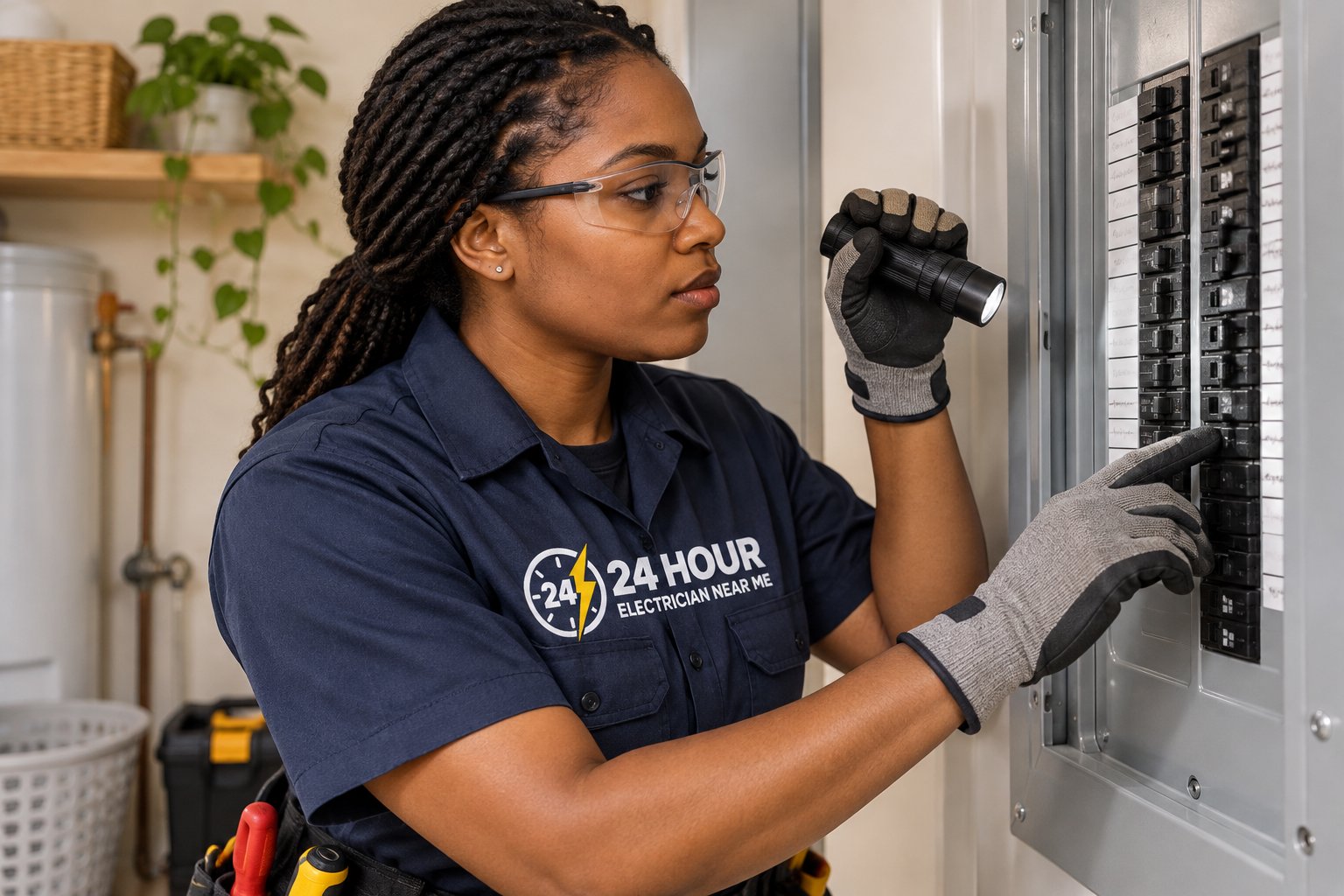
An arc-fault breaker looks like a standard breaker with an added test button, but inside it carries electronics that a plain thermal-magnetic breaker lacks. A regular breaker reacts to overloads and short circuits. An AFCI also watches the shape of the current waveform, listening for the jagged, irregular pattern that sparking creates. That sparking can come from a nail that nicked a cable, a loose terminal screw, a cord pinched behind furniture, or insulation that has become brittle with age. In South Florida homes, heat in attics and humidity in older wall cavities can speed that kind of wear, which is one reason arc protection draws interest here.
When the breaker recognizes a worrying pattern, it trips and removes power from the circuit before the sparking has time to heat nearby wood or insulation. The technician explains this behavior during a visit so you know the difference between a trip caused by a real fault and one caused by an appliance with a motor that mimics arcing. Vacuum cleaners, older power tools, and some dimmers can occasionally trigger a trip, and sorting out which device is responsible is part of the diagnostic work. If your panel keeps tripping, call us and describe what was running at the time.
Replacing or adding an AFCI breaker is not simply swapping one part for another. The electrician first confirms the panel brand and which breaker models it accepts, then checks the neutral wiring on the circuit, because shared or mixed neutrals commonly cause nuisance trips with arc protection. The scope is explained before any work begins, so you know whether a single breaker, a wiring correction, or a broader review of the circuit is needed. Please call us to talk through your situation and confirm availability, and leave panel work to a professional rather than opening the cover yourself, since live panel parts are dangerous to touch.