
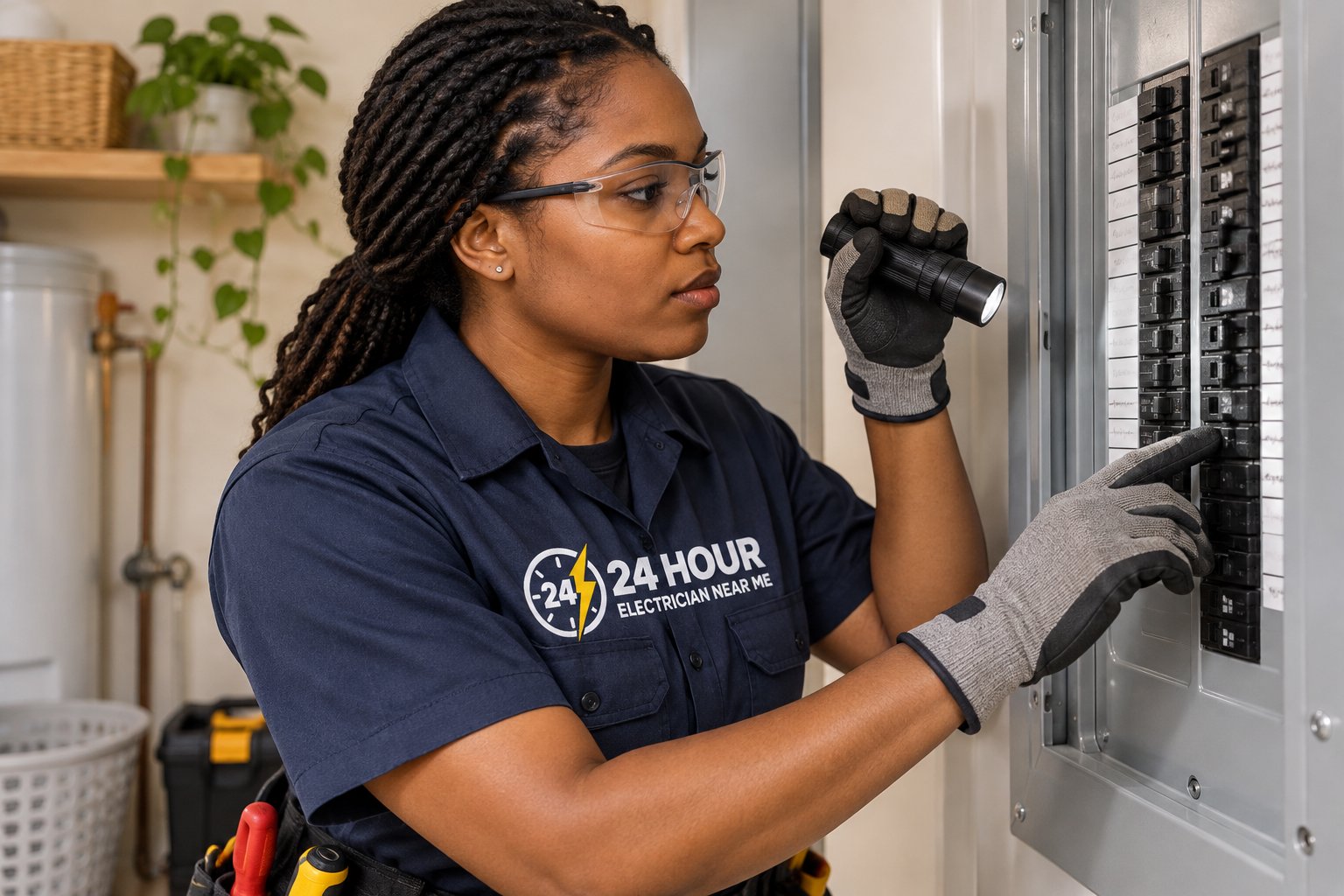
Do not open a panel to investigate a symptom.
Call 911 and move away when there is active fire, smoke, arcing or an immediate threat. Do not stand in water to reach electrical equipment. Do not remove the panel cover, touch exposed components or insert tools. If a breaker trips again after a reset, stop repeatedly resetting it. A breaker or fuse is a protective device; recurring operation can indicate a problem that needs qualified evaluation.
From a safe distance, a customer can report whether the full property or one circuit is affected, whether unusual heat, odor, noise or discoloration is present, when the condition began, and whether a storm, leak, renovation or new appliance preceded it. If the meter, service conductors or utility equipment appear damaged, keep away and contact the utility. These observations help route the request without turning the customer into a technician.
Fire, smoke, active arcing, a downed line or energized water is not a normal appointment. Leave the hazard and contact emergency services or the utility as appropriate.

A panel visit does not automatically end in replacement.
Investigate
The reported symptom may originate in a branch circuit, device, appliance, connection or utility condition rather than the panel itself.
Repair
A qualified assessment may identify a serviceable component or connection within the permitted and manufacturer-supported scope.
Replace
Damage, incompatibility, condition, project requirements or unavailable suitable components may support replacement.
Upgrade or manage capacity
New loads can require more capacity, a different configuration, load management or another engineered approach.
The provider should explain which outcome is recommended and why. A brand name, cabinet color, property age or insurance question by itself is not a complete diagnosis. The recommendation should connect observed condition, testing, listed equipment, available capacity, code requirements and the customer's goals.
When the problem may be elsewhere
One dead outlet, one appliance that will not start or one room without power can be caused by conditions outside the main panel. Troubleshooting should identify the affected circuit and loads before a large project is proposed. Likewise, an area outage or utility-side problem is not corrected by replacing customer equipment.
When repair may be considered
Repair depends on the actual condition, availability of suitable listed components, manufacturer information, code requirements and whether damage extends beyond one part. It should explain that the provider will document the basis for a repair recommendation and any remaining limitations.
When replacement may be considered
Replacement can be appropriate when equipment is damaged, compromised, unsuitable for the needed work, unable to accept appropriate components, or part of a larger service alteration. The proposal should identify the reason and whether related work, meter equipment, grounding, service conductors, labeling, wall repair or utility coordination, is included.
A recommendation should be traceable to facts.
A strong assessment separates the customer's reported symptom from the provider's observations and testing. The customer may report flickering, heat or a repeated trip; the provider then documents what was inspected, what was measured within scope and which condition supports the recommendation. This distinction prevents a concern from being presented as a confirmed defect before evaluation.
When repair is recommended, the record should identify the affected component, why repair is permitted and suitable, and whether related equipment remains serviceable. When replacement is recommended, the record should identify the specific limitation or damage that makes replacement the better path. If the project is driven by added electrical demand rather than failure, the proposal should say that plainly.
Customers should also understand alternatives. A capacity project may involve a conventional service upgrade, a differently configured panel, a subpanel, load-management equipment or changes to the proposed load. Not every alternative fits every jurisdiction, utility or property. The provider should evaluate compatibility and permitting instead of advertising a universal shortcut.
A recommendation can change after concealed conditions become visible under safe working procedures. If that possibility exists, the estimate should describe the assumption and the approval process for additional work. The customer should not be surprised by a materially different project after equipment is opened.
What a useful panel evaluation should clarify.
Reported condition
The visit begins with the customer's timeline: what changed, which circuits are affected, whether breakers trip, whether new equipment was added, and whether storm, water or renovation activity occurred. Intermittent symptoms should be described with the time and loads operating when possible.
Installed equipment
The provider identifies the panel or service equipment, ratings, main disconnect arrangement, circuit count, labeling and visible condition. Equipment should be evaluated using manufacturer information and applicable requirements, not internet rumors. Customers should not remove covers to supply model information.
Signs of damage or deterioration
Heat effects, corrosion, water entry, damaged enclosures, improper openings, loose or unsuitable components and other observed conditions may influence the recommendation. A coastal environment is relevant context but does not prove replacement is necessary. The actual equipment must be assessed.
Grounding, bonding and service context
A panel project may interact with grounding and bonding, service disconnects, meter equipment and utility requirements. The proposal should identify related work rather than treat the cabinet as an isolated object. Some conditions may require utility coordination or access to other parts of the property.
Branch circuits and labeling
Accurate circuit identification helps safe operation and future work. A panel visit can document missing or unclear labels, but labeling should follow actual identification rather than guesses. Existing branch-circuit concerns may need separate troubleshooting and should not be hidden inside a broad panel quote.
Testing and limitations
The provider should state what testing was completed and what was outside the visit. A visual inspection, diagnostic visit and comprehensive system assessment are not the same service. Concealed wiring cannot be represented as verified without appropriate access and testing.
More electric equipment does not always mean the same solution.
The U.S. Department of Energy explains that panels distribute electricity to circuits and that panel capacity affects how much power a home can use at once. EV chargers, heat pumps, electric water heating, cooking equipment, additions and other loads can change demand. Planning should consider the existing service, calculated load, proposed equipment and operating characteristics.
A larger panel cabinet does not necessarily mean the utility service has been increased. Panel spaces, bus rating, main protection, conductors, meter equipment and utility supply are related but distinct. A proposal should be precise about whether it covers a panel replacement, service upgrade, subpanel, new circuit, load-management equipment or another approach.
EV charging
Charger power, duty cycle, panel capacity, parking location and wiring route affect the project. Load management may be an option in some designs, while other properties need additional capacity. Condominiums and commercial garages add association, metering, shared-infrastructure and engineering questions.
Generators
Transfer equipment must be coordinated with the service and selected circuits. A portable generator must never backfeed building wiring through an improvised connection. A panel project connected to generator planning needs a defined operating design, equipment selection and permit route.
Additions and remodeling
New rooms, kitchens, equipment or tenant improvements can introduce circuits and change load calculations. Panel planning should be coordinated with the complete project and other trades. A master permit or design professional may be involved depending on scope.
Alternatives and limitations
DOE research recognizes that capacity constraints can sometimes be addressed by solutions other than a conventional service upgrade, including load-management approaches. Whether an alternative is permitted, compatible and appropriate depends on the property and project.
The panel may be only one part of the work.
A service change can involve the electrical contractor, utility, building department, property owner and sometimes an association, landlord, engineer or other trade. The sequence matters. Equipment availability, permit approval, utility scheduling, inspections and access can affect the timeline.
For a condominium, the proposed work may depend on common feeders or meter rooms. For a commercial tenant, the landlord may control upstream equipment. For a remodel, the panel scope may be tied to a master permit.
Any planned shutdown should be communicated to occupants and businesses. Refrigeration, medical needs, security, internet equipment, elevators and access systems may require separate preparation. The electrical proposal should identify the expected outage and who coordinates affected parties; it should not imply that every panel project is a quick swap.
Responsibility and access can change the project.
Single-family homes
The homeowner can usually provide access and authorization, but utility equipment, easements, outdoor working space and permit requirements still matter. The office should ask whether the project supports another installation and whether the customer has product documents or plans.
Condominium units
The unit panel may be privately controlled while feeders, meters and service equipment belong to the association. A proposed upgrade can affect common infrastructure. Association approval, engineering review, contractor documents, elevators and work hours may be required before the project is feasible.
Rentals and multifamily buildings
Tenants can report symptoms but usually need owner or management authorization. When several units are affected, the issue may involve common equipment. The provider should identify the approving party, access contact and distribution boundary before quoting a unit-level repair.
Commercial tenant spaces
A tenant panel can depend on base-building distribution, landlord rules and operating schedules. The business contact should identify critical loads, shutdown limitations and who controls upstream equipment. Commercial work may require plans, coordination and inspection beyond a residential-style appointment.
Managed and institutional properties
Property managers need clear documentation, permit status, shutdown planning and closeout records.
Verify both the contractor and the authority having jurisdiction.
Florida's Electrical Contractors' Licensing Board licenses and regulates electrical contractors. The state explains that certified contractors may operate statewide within their scope, while registered contractors are limited to the jurisdictions where they are registered.
Panel replacement, service changes, new circuits and capacity projects commonly require permits, but the exact path depends on scope and jurisdiction. Broward County and the cities from Boca Raton to North Miami contain multiple municipal building departments.
A proposal should state who obtains the permit, whether utility coordination is needed, which inspections are anticipated, and what work is excluded. Customers should have the permit record and approved documents when applicable. A service provider should not ask a customer to pull an owner-builder permit merely to avoid contractor responsibility.
What should be clear before work is authorized.
When the provider cannot know the complete scope until equipment is opened under safe conditions or testing is completed, the proposal should explain the uncertainty. A change should require customer authorization. For a managed property, the approving representative and communication plan should be recorded. Material substitutions, revised shutdown needs and newly identified permit requirements should also be explained before the customer approves a changed scope.
Closeout
The customer should receive documentation of completed work, equipment information, circuit labeling, permit or inspection status and any remaining recommendations. Optional improvements should be separated from required corrections. Photographs should relate to authorized work and be taken with permission. If utility reconnection, a final inspection, wall repair or another trade remains outstanding, the closeout record should identify the responsible party and next action. For a rental, condominium or commercial property, the owner or manager may need the same documentation provided to the occupant.
- Reason: the documented basis for repair, replacement or capacity work.
- Equipment: the proposed panel, breakers, disconnects or related components.
- Included work: circuits, service equipment, grounding, labeling, patching and coordination.
- Exclusions: utility work, engineering, wall repair, other trades or concealed conditions.
- Permit responsibility: who applies, schedules inspection and closes the record.
- Shutdown: expected outage, access and property preparation.
- Price: legitimate charges, allowances and change conditions.
- Warranty: actual workmanship and manufacturer terms without invented claims.
Warning signs worth reporting before they get worse
Panels give signals, and most are easy to notice without touching anything. A breaker that trips repeatedly, a panel door that feels warm, a buzzing or crackling sound, a burning or fishy odor near the panel, discolored or scorched areas and lights that flicker or dim when appliances start are all reasons to call. Rust, moisture or signs of insects around an exterior panel are also worth reporting.
If you notice any of these, avoid opening the panel and avoid repeatedly resetting breakers. A breaker that trips is protecting the circuit, and resetting it again and again does not fix the underlying cause. If the smell is strong, if you see smoke or sparks, or if anyone has felt a shock from an appliance or the panel, move away and call 911. Then call an electrician once the situation is safe.
When you call, describe what you saw and when. Mention which breakers are involved, what appliances were running and whether the problem happens at specific times of day. These details help narrow down the cause, such as a worn breaker, a loose connection or an overloaded circuit, and help the technician plan what to bring. The visit then focuses on testing and explaining findings rather than guessing.
Planning around the panel when you add new equipment
Panels are often the limiting factor when a household adds equipment. An electric vehicle charger, a heat pump, an induction range, a pool heater or a hot tub can each add a large, continuous load. Even if a panel has open slots, the service as a whole may not have capacity for the added demand. Evaluating that capacity requires looking at the main breaker rating, the service conductors and the existing loads.
A technician may perform a load calculation, which is a structured way of estimating the demand a building can place on its service. The result tells whether the existing service can handle a new load, whether load management equipment could help or whether a service upgrade is the better path. Each of these options has different consequences for cost, schedule and permitting, which is why quotes for this kind of work are given by phone after the facts are gathered.
If you are considering several additions, plan them together. Doing so avoids upgrading a panel for one project and discovering that the next project needs another change. Bring a list of what you plan to add, product information if you have it, and any limits from an association or landlord. A complicated job may require an on-site visit before a quote can be given, and the service call charge for that visit is explained on the phone before dispatch.
Practical answers without sales shortcuts.
Does an old panel automatically need replacement?
No. Age is context. Condition, compatibility, capacity, testing, code and project needs determine the recommendation.
Does a tripping breaker mean the panel failed?
Not necessarily. The cause may involve a circuit, load, device, connection or breaker. Repeated trips need qualified evaluation.
Can a panel be priced from a photo?
A safe photo can help identify equipment, but capacity, service, grounding, access, permits and concealed conditions affect scope.
Is a panel replacement the same as a service upgrade?
No. They can overlap, but panel equipment and utility-service capacity are distinct. The proposal should define the project.
Do EV chargers always require an upgrade?
No. Capacity, charger settings, calculated load and possible management solutions must be evaluated.
Can I replace a breaker myself?
Panel work can expose energized parts and should be handled by properly qualified personnel.
Will power be shut off?
Many panel and service projects require a planned shutdown. Duration and utility coordination depend on scope and approvals.
Dealing with "Repair, replace, expand, or investigate first?"? Tell us where in the building it happens and what changed before it started. We will say what the electrician would check and how the visit charge is explained.
Related pages
- Home: Electrical repair and installation for homes and businesses in Broward County and the cities from Boca Raton to North Miami. Quotes by phone, clear steps, safety first.
- AC Electrical Work: Electrical work for air conditioners: disconnects, whips and breaker sizing at outdoor units, and why the electrician and AC contractor coordinate.
- Guest Suite Power: Electrical planning for a converted garage, in-law suite or detached unit: feeder size, subpanel choices, load calculations, metering and inspection steps.
- Aluminum Wiring: Aluminum branch wiring from the 1960s and 1970s: why it needs attention, repair options from connectors to partial replacement, and how a technician decides.
- Arc-Fault Breakers: Where arc-fault breakers apply, why they trip on certain loads, and how a technician adds arc-fault protection to existing circuits in older homes.
- Bathroom Fans: Wiring and replacing bathroom exhaust fans, fan and light combinations, humidity-sensing controls and the electrical details around venting.