
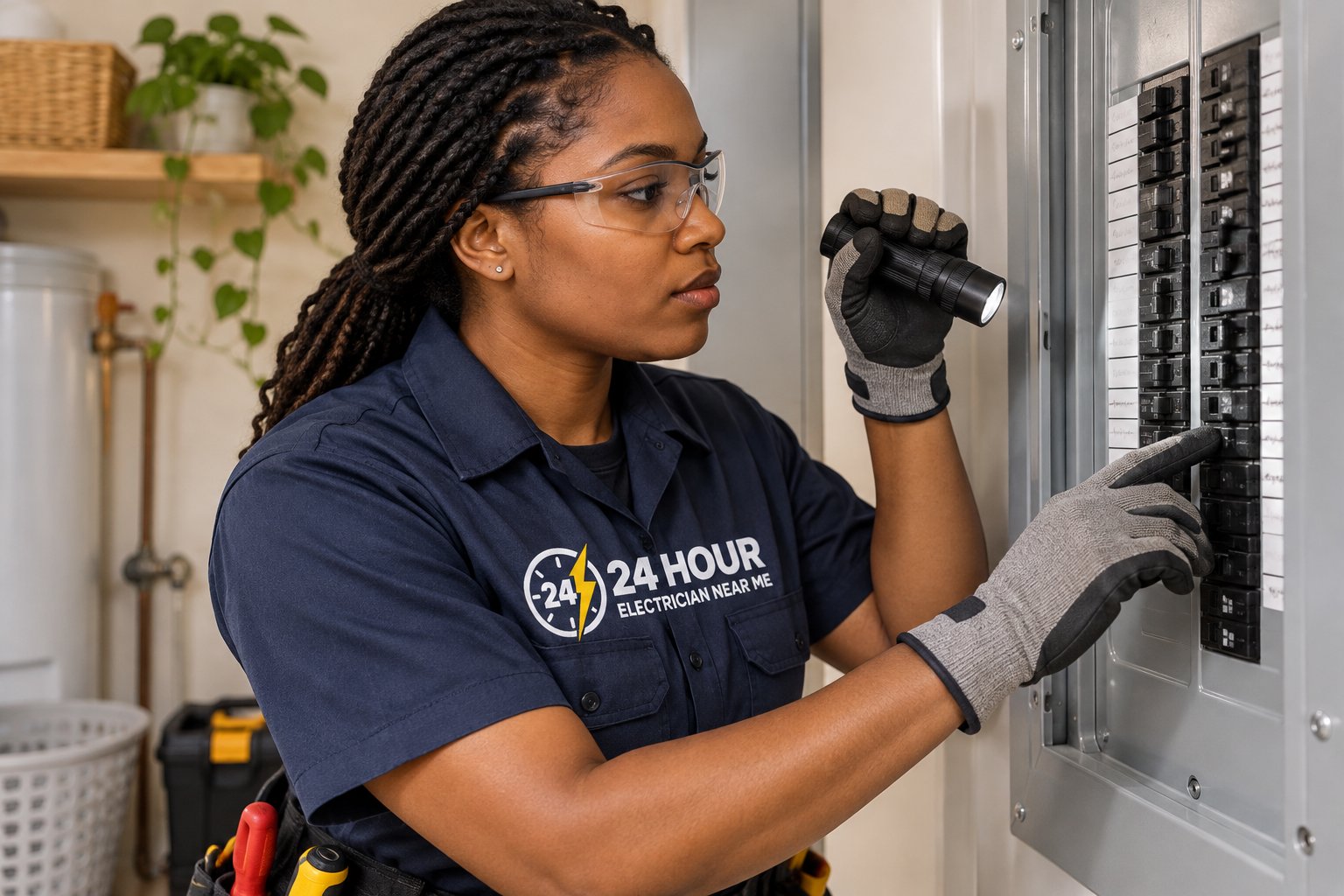
A website request is not emergency dispatch.
Call 911 and move to a safe location for fire, smoke, active arcing, electrical contact or an immediate threat to people. Stay away from downed conductors, standing water near electrical equipment and damaged exterior service components. Report utility outages and utility-owned equipment concerns through the utility's official channel.
For heat, burning odor, buzzing, repeated breaker operation, visible scorching, water exposure or impact damage, stop using the affected area or equipment when that can be done safely. Do not open panels, touch wet devices or repeatedly reset protection. The intake should flag the condition and provide safety instructions; it should not claim to diagnose the cause or guarantee arrival.
Actual coverage, business hours, on-call staffing, technician availability and response windows must be confirmed and displayed accurately before launch.

Clarity matters more than pressure.
Verify first
Confirm the business, contractor license, service area, scope and person authorizing work.
Separate stages
Do not confuse an intake, appointment request, diagnostic visit, estimate, permit or completed repair.
Document decisions
Record reported symptoms, scope, price basis, changes, testing, permits, warranty and unresolved items.
A customer should know whether a call is requesting availability, booking a confirmed appointment or authorizing paid work. The website should use those verbs precisely. A form submission does not mean a technician is dispatched. A diagnostic fee does not automatically purchase repair. An estimate is not final when site conditions or concealed problems remain unknown unless the business expressly defines it that way.
The same clarity protects commercial customers. A tenant may request a visit but lack authority to change base-building electrical systems. A facilities coordinator may authorize diagnosis but need purchasing approval for repair. One named decision-maker and a written approval path reduce confusion.
Collect enough information to route safely, not every possible detail.
The intake should ask for the property address, city, unit or suite, property type, service category, safe symptom description, warning signs, requester's role, access constraints and preferred contact method. For planned work, request equipment model, project stage and desired outcome. For a problem, ask what is affected, when it began and whether it is recurring.
Do not ask customers to remove covers, inspect live parts, enter restricted electrical rooms or recreate a fault. Photographs should be optional and limited to safely visible conditions. Avoid collecting identity documents, payment cards or unnecessary sensitive information through an ordinary contact form.
Residential requests
Confirm owner, renter or condominium status. A renter may need landlord approval; a condominium project may involve association rules or common-area access. The person at the property should know who can authorize work and receive pricing.
Commercial requests
Ask for the company, site contact, affected operation, landlord or property-manager contact, equipment vendor, shutdown window and purchasing authority. Specialized, industrial and life-safety systems need separate capability review before acceptance.
Privacy and consent
The office confirms fit, geography and availability.
Routing checks whether the request is within the verified service category and real operating area. For this electrician brand, the intended region is Broward County and the cities from Boca Raton to North Miami, but no public coverage claim should appear until the operating business confirms technician reach, licensing and scheduling. Equal editorial coverage does not prove equal operational availability.
The office should distinguish utility work, building management responsibility, appliance or equipment vendor work and electrical contractor work. A neighborhood outage goes first to the utility. A condominium common-area issue needs management coordination. A failed appliance may need manufacturer service even when the outlet also deserves evaluation.
Once fit is confirmed, offer a real appointment window based on current schedule, travel, parts, access and project type. Do not use a universal two-hour arrival claim. A diagnostic visit, planned estimate and installation appointment may require different windows.
Prepare access without touching electrical equipment.
The customer should not clear a path by entering a flooded room, leaning over damaged equipment or removing a panel cover. If safe access is unavailable, the appointment may need coordination with emergency services, the utility, property management or another trade.
- Confirm the complete address, gate, parking and unit or suite instructions.
- Identify the adult or authorized facility representative who will meet the technician.
- Arrange landlord, condominium or electrical-room authorization.
- Move ordinary belongings only when they can be handled safely; do not move hot or damaged equipment.
- Keep children, pets, customers and employees away from the work area.
- Collect equipment manuals, prior invoices, permit records and safe photographs.
- Explain business shutdown limitations, building rules and restricted working hours.
- Report any change in symptoms, especially heat, odor, water, smoke or loss of power.
Confirm identity, scope and price basis before testing begins.
The arriving professional should identify the business and explain the visit purpose. The customer can verify the license information displayed in the contract or vehicle against Florida's official database. A branded shirt or van is not proof of licensure by itself.
Before chargeable work, the provider should state any service or diagnostic fee, what it includes and whether it is applied to authorized repair. The customer should know whether the visit covers one reported condition, a defined group of circuits or a broader assessment. A limited visit is not a certification of the entire property.
The electrician reviews the reported history, safe conditions, accessible equipment and relevant records. Testing follows the actual symptom and agreed scope. If the condition lies with the utility, appliance, landlord system or another specialty, the provider should explain the handoff rather than invent work.
Confirm the customer and property
Match the request, address, authorized person, access and reported condition.
Review safety and boundaries
Identify hazards, occupied areas, shutdown limits and equipment outside scope.
Explain the assessment
State what will be evaluated, the fee basis and what the visit does not include.
Gather evidence
Inspect and test appropriately, documenting accessible equipment and conditions.
Present findings
Separate verified cause, contributing conditions, uncertainty and recommended next steps.
A useful estimate lets the customer compare the same work.
Florida DBPR consumer guidance recommends written estimates that identify the work, materials, completion timing and total cost. The Federal Trade Commission likewise recommends written estimates and careful contract review. For electrical service, a clear estimate should describe the affected equipment, proposed correction, parts or allowances, permit responsibility, inspection, access, restoration, cleanup, warranty, exclusions and change-order process.
Some repairs can be priced after diagnosis. Larger work may require design, equipment selection, utility coordination or a separate proposal. If an exact total cannot yet be established, explain the pricing method and what information remains. Do not convert uncertainty into a false flat price.
Compare scope, not only the bottom line
One proposal may include permit, inspection, listed equipment, wall repair or broader corrective work while another excludes them. Ask why the scopes differ. A low number is not comparable if it omits the condition the customer needs resolved.
Optional work
Separate required correction, recommended improvement and optional upgrade. Do not imply that every older component is unsafe or that planned enhancement must be completed during an urgent repair. The customer should understand the consequence of declining each item.
Credentials and identity
No added work without a documented decision.
The person approving work must have authority for the property or business. For a rental, condominium or commercial tenant, financial authorization and building authorization may come from different parties. The provider should record who approved the scope and how approval was communicated.
For urgent stabilization, define the temporary result and remaining restriction. "Make safe" might leave equipment disconnected or an area without power until a permanent repair, permit, part or approval is available. The written authorization should say so.
Pause, explain and price the difference.
Electrical work can reveal inaccessible damage, unsuitable equipment, an unexpected wiring method, water exposure or a route that differs from plans. A change is not automatically evidence of poor estimating, but it requires transparency. The provider should show the condition where safe, explain why it affects the scope, present alternatives and obtain authorization before continuing beyond emergency stabilization.
A change order should identify added or removed work, price effect, schedule effect, permit effect and unresolved assumptions. Photos and notes can support the record without exposing energized parts to the customer. For managed properties, send the change to the designated approver rather than whoever happens to be present.
If the provider discovers work outside its verified license or capability, it should stop and coordinate the appropriate professional. The customer should not be pressured to accept an improvised workaround.
Responsibility belongs in the written scope.
Permit requirements depend on the work and the authority serving the exact address. Broward County and the cities from Boca Raton to North Miami contain multiple municipalities. The provider should confirm the jurisdiction, submission, inspection stages and who closes the permit. A website cannot state that all repairs are exempt or guarantee approval.
DBPR warns consumers to check local building-department requirements and to be cautious when a contractor refuses to pull required permits or asks the homeowner to act as permit applicant. The correct permit arrangement depends on Florida law and local process; it should be verified for the project rather than improvised.
Inspection confirms the permitted work against the approved scope; it is not a warranty for unrelated property systems. Corrections should be documented and scheduled, and final approval records should be included in closeout when applicable.
The customer should leave with a usable record.
Closeout identifies the original complaint, assessment, work performed, equipment or parts, testing, permits, inspection status, warranty, payment and any limitation. Update panel schedules and equipment labels when the project requires it. For commercial and managed properties, send records to the facility contact as well as the on-site representative.
If a symptom could not be reproduced, say so. Record what was accessible and tested, what remains uncertain and the next observation or follow-up plan. Replacing parts without evidence is not a stronger closeout.
Explain normal operation and customer maintenance without instructing the customer to enter electrical equipment. Provide product manuals, settings and manufacturer registration details when relevant. Smart controls should be transferred to the customer's account, not left under a contractor's personal account.
A final invoice should match the authorized scope and approved changes. If utility, manufacturer, association, inspector or another trade still has work, name the responsible party and current restriction.
Use official records, not advertising signals.
Florida DBPR states that electrical contracting for compensation requires appropriate licensure and provides an official license lookup. Verify the individual contractor, business relationship, status and scope. A business registration, tax receipt, domain name, paid advertisement, branded vehicle or search ranking is not a substitute.
Ask for current insurance evidence and compare the contracting name with the license and proposal. Obtain written scope and keep estimates, contracts, invoices, permit records, photos and communications. The FTC recommends multiple estimates and warns against pressure, unusual payment demands and financing arrangements that are not understood.
Identity red flags
No verifiable license, inconsistent business names, refusal to provide a physical business identity or pressure to skip permits.
Payment red flags
Demand for full payment before work, cash-only pressure, wire-transfer requests or unexplained financing.
Scope red flags
Blank contract fields, vague "complete repair," no materials, no exclusions or refusal to document changes.
Urgency red flags
Claims that a reductions disappears immediately or that every older component must be replaced without evidence.
The process changes with ownership.
Homeowner
The owner can approve work, but utility, permit and association dependencies may remain. Keep records with property documents.
Condominium owner
Confirm association alteration rules, electrical-room access, insurance and common-property boundaries before scheduling invasive work.
Renter
Notify the landlord or manager except when immediate danger requires emergency action. Do not authorize building alterations without permission.
Commercial tenant
Separate tenant equipment from base-building systems and name the landlord contact. Purchasing approval may differ from on-site access approval.
Property manager
Use work-order numbers, consistent site contacts, photos, equipment IDs and closeout fields across the portfolio while preserving site-specific diagnosis.
Bring facts, authorization and safe access.
- Complete address, unit or suite and municipality.
- Property type and requester's role.
- Specific service or symptom in plain language.
- Heat, odor, water, smoke, shock, arcing or damage.
- When the problem began and whether it repeats.
- Safe photographs and equipment model information.
- Owner, landlord, association or facility contact.
- Electrical-room, gate, parking and work-hour access.
- Business shutdown or household continuity concerns.
- Prior repair, permit or utility information.
- Preferred appointment periods, not assumed arrival.
- Contact consent and preferred communication method.
Know exactly what each step means.
Does submitting the form confirm an appointment?
Can the price be guaranteed over the phone?
Only when the business has enough verified information and its policy supports that commitment. Many diagnostic conditions require assessment first.
What does a diagnostic fee include?
The business must define it in writing. It may cover a specified visit and assessment scope, not every repair or entire-property inspection.
Can a tenant approve repair?
It depends on the lease and owner or management authorization. Emergency safety action and contractual approval are different questions.
Who obtains the permit?
The written scope should state responsibility. Requirements depend on the exact work and jurisdiction.
What if more damage is discovered?
The provider should explain and document the condition, present a change in scope and obtain authorization before added work except necessary emergency stabilization.
How do I verify the contractor?
Use Florida DBPR's official license lookup and compare the individual, business entity, status and scope with the proposal.
Does "24 hour" guarantee immediate arrival?
No. The production site must accurately state actual request hours, coverage and availability; every appointment window requires confirmation.
Official references
Dealing with "Know the process before authorizing the work."? Tell us where in the building it happens and what changed before it started. We will say what the electrician would check and how the visit charge is explained.
Related pages
- Inspection Day: Get ready for rough and final electrical inspections: access, labeling, timing with open walls, and what inspectors typically look at on each visit.
- Electrical Permits: How electrical permits and inspections generally work in Broward County and the cities from Boca Raton to North Miami, and what owners should expect from the process.
- Kids and Pets: Practical electrical safety for homes with small children and curious animals: outlets, cords, chargers, appliances, outdoor areas and when to call.
- Emergency or Not: A triage list for electrical symptoms: which need immediate action and a call right now, and which can safely be scheduled for a later visit.
- Flood Zone Planning: How elevation rules shape panel and equipment placement on coastal and low-lying South Florida lots, and what to settle before electrical work begins.
- Flood Safety: What flood-exposed panels, outlets and wiring require before a home can be re-energized, and why drying equipment out is not the same as making it safe.
What a clear scope sounds like when it is explained to you
A good scope explanation is plain and specific. It names the circuits, rooms, or equipment involved, says what will be removed and what will be installed, and explains which parts are being left alone on purpose. If you hear vague phrases such as fixing the wiring or bringing everything up to date, ask what that means in practice. You are entitled to understand the work before it starts, and a thoughtful technician will welcome the questions because they reduce surprises for everyone. Wherever uncertainty remains, a careful on-site look is worth more than any general advice found online or in print.
Listen for how conditions are handled. Electrical work in older buildings sometimes reveals things behind walls that nobody could see in advance, such as damaged insulation, undersized wiring, or earlier repairs done by someone else. A clear scope explains what happens if that occurs: work pauses, the finding is shown or described, and a decision is made together before any added work proceeds. This keeps the original agreement understandable and gives you a chance to consider options rather than feeling hurried. A short list kept on your phone is often more useful than memory, especially when several people in the household are involved.
Write down the points you want to confirm and ask them calmly. What is the exact task? What will you need to prepare, such as clearing access to the panel? Does the work require a permit or an inspection? What will be left in place after the visit, and what records will you receive? If something is unclear, say so before authorizing anything. When you are ready, call us to talk through the process, and the office can confirm availability for your area. Plan for some inconvenience during the visit, such as parts of the home being without power for a period that cannot be promised in advance.
Keeping the record after the work is finished
The work is not truly complete when the technician leaves; it is complete when you understand what was done. Ask for a plain description of the tasks performed, the locations involved, and any parts that were replaced. If circuits were relabeled or devices moved, make sure the new arrangement is written down. This simple document becomes valuable later, when you sell the property, hire another contractor, or try to remember why a breaker was changed. It is reasonable to compare options and take a day to think, as long as no urgent hazard is present in the meantime.
Keep related papers together in one place: the written scope, any permit information, inspection notes if an inspection took place, and photographs taken during the visit. If something was found that was not part of the original request, note what was found and what decision was made about it. Items deferred for later are worth recording too, along with the reason, so that a future visit begins with context instead of guesswork. A single folder or digital file is enough. Patience pays off, because sound electrical work depends on testing and checking at each stage rather than on speed.
Check the work yourself in simple ways. Switch on the lights and appliances the visit was about, and look for anything that behaves differently than expected. If a breaker trips, a device feels warm, or a smell appears, stop using that circuit and call a professional rather than waiting. Never open panels or junction boxes to investigate. If you have a question about the record you received, call us and the office can walk through it and confirm availability for any follow-up. If a question comes up that nobody can answer on the spot, it is better to pause and find out than to guess.