

Why renovations break circuits that were working
A house's wiring is hidden, and that is exactly why renovation can break it without anyone noticing. Electrical cables run through studs, joists and ceiling cavities in paths that rarely follow a straight line. They pass from box to box, feeding outlets, switches and fixtures in sequence. When a wall is opened, a ceiling is lowered, a kitchen is gutted or a bathroom is reworked, those cables are in the path of the work.
Several things can go wrong. A cable may be cut or nicked by a saw or reciprocating blade. A staple may be driven through insulation. A junction box may be buried, removed, covered or moved. Wire connections inside a box may be pulled apart, left loose or shoved aside. A fixture may be removed and its wires left uncapped. Insulation blown or stuffed in a cavity may pinch or cover wiring. A circuit that powered several areas may be interrupted at a point that feeds everything downstream.
The result often looks puzzling. One outlet is dead, but the lights in the same room work. A whole wall of outlets has no power, but a different room is fine. A kitchen counter has no power, while the refrigerator on a different circuit does. Switches that used to turn lights on do nothing. The pattern usually follows the path of the cable, and reading it carefully tells you where the break is likely to be.
Sometimes, the loss of power is not an accident. Circuits may have been disconnected deliberately during demolition for safety and never reconnected, or the breaker may have been switched off by workers and not turned back on. Always check the simple possibilities first.
Safety is the first concern. Dead circuits after renovation can hide exposed live conductors, uncapped wires and unfinished connections. If you see exposed wires, scorched parts, sparks or smell burning, keep everyone away and call a qualified electrician. If anything is smoking or on fire, leave and call 911. Our page on the renovation electrical timeline shows where electrical work fits in a project.
Start with the simple checks
Before assuming a hidden fault, rule out the easy explanations. They account for a surprising number of cases.
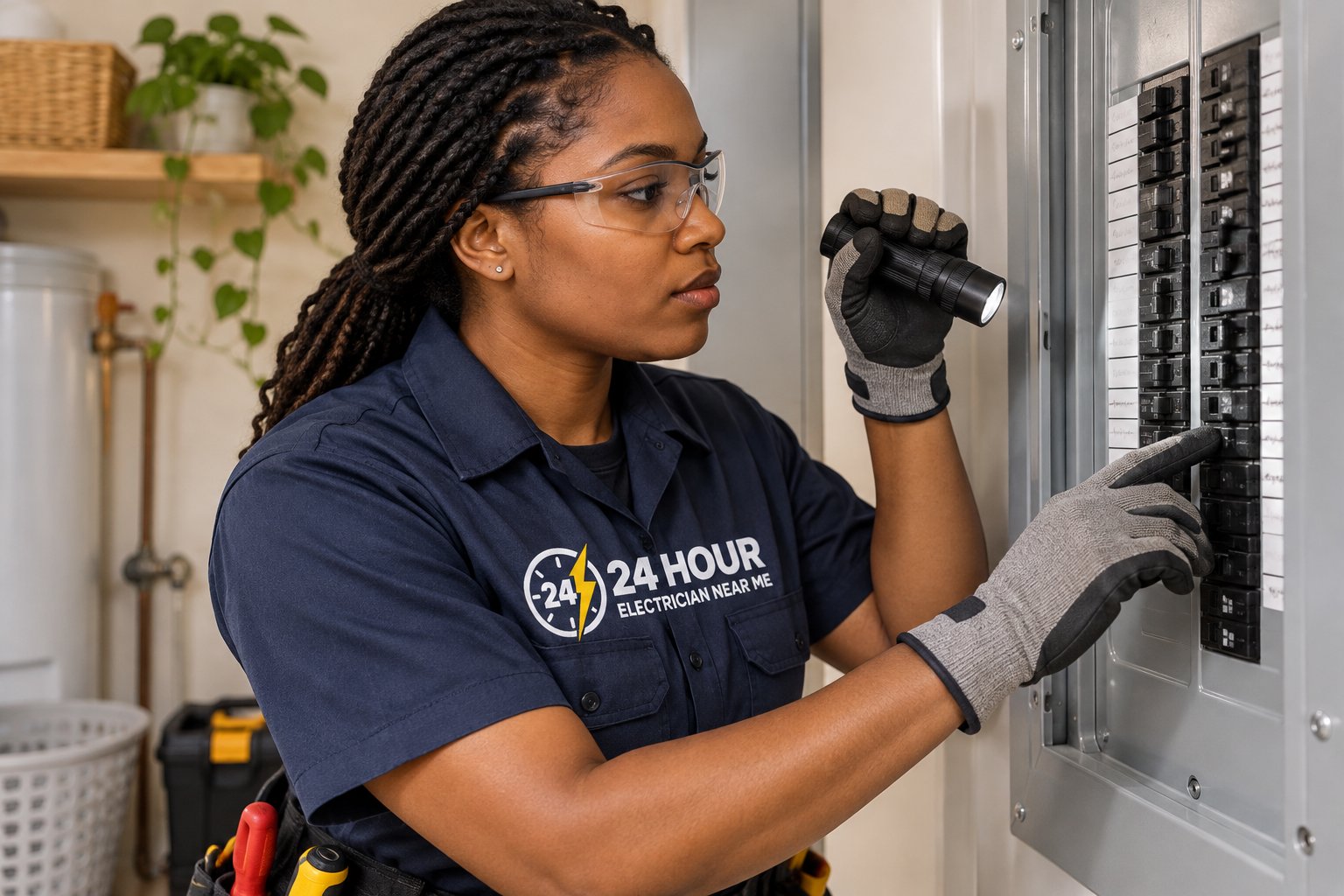
Check the panel. Open the panel door and look for tripped breakers, which sit in a middle position or show a color flag, depending on the type. Workers may have switched breakers off to work safely and forgotten to turn them back on. Flip a tripped breaker fully off and then on again once. If it trips right away, stop; there is a short or overload that needs a technician.
Check ground fault outlets. Many kitchens, bathrooms, garages and outdoor areas are protected by GFCI devices that can feed several outlets. A tripped GFCI in a different room, or one hidden behind a cabinet or a new appliance, can make a whole area dead. Press reset on every GFCI you can find. Our page on GFCI that will not reset explains what to do if it will not hold.
Check switched outlets. Some outlets are controlled by a wall switch, which is common in living rooms and bedrooms. If the switch was replaced, moved or covered, the outlet may seem dead. Try the switch.
Check what is plugged in. Test the outlet with a lamp or a phone charger you know works. Remove surge strips or extension cords from the picture.
Look at the area. Note whether there are open walls, missing covers, boxes without devices, loose wires and capped or uncapped conductors. Do not touch any bare wire, even if you believe the circuit is off. A wire that appears dead may be energized through a different circuit or a shared neutral.
If those checks do not restore power, the problem is in the wiring, and the pages below explain the likely locations. Our broader page on an outlet that is not working covers the general case, while this page covers the renovation context.
Disturbed junction boxes and loose connections
The most frequent cause of dead outlets after renovation is a connection that was disturbed. Wires in a box are joined with connectors or terminals, and all the circuit's downstream devices depend on those joints. If a joint is pulled apart or loosened, everything beyond it loses power.
Typical scenarios: a wall is demolished and the junction boxes in it are left dangling, with wires pulled loose; a box is moved or replaced, and the new connections do not carry the circuit through; insulation or drywall contractors push wires out of the way and loosen connectors; a ceiling is lowered and a box that was reachable is now hidden above the new surface.
Back-stabbed connections, where wires are pushed into holes on the back of an outlet, are especially vulnerable. They hold by spring tension. A tug on a cable can release the wire, and in a chain of outlets, that releases everything downstream. This is one reason a single outlet at the start of a run can take down an entire wall.
Hidden boxes are a safety problem. Junction boxes must remain accessible. If a box was covered by new drywall, a cabinet or a ceiling, it needs to be uncovered and given an access cover. Finding a buried box is often the key to locating a dead circuit, since splices in it may be the break. Our electrical corrections page describes how problems like these are brought up to standard.
Fixture changes cause similar trouble. When a ceiling light, fan or vanity light is replaced, the wires in the ceiling box may be rearranged. If a wire nut is incorrectly applied, or a wire that feeds other devices is disconnected, the circuit loses continuity. Replacing a fixture can therefore leave outlets or lights elsewhere dead. See lighting installation and repair for what proper work involves.
Cut, nicked or removed cable
A cable that has been severed or damaged stops the circuit at the point of the break. During demolition, cables are easy to hit, especially when the layout is not known. A cable running through a wall that was removed may have been cut and left, with the cut ends stuffed back in a cavity or simply abandoned.
Nicks are more insidious. A blade or a staple may damage the insulation of a conductor without fully cutting it. The circuit may work for a while, then fail when the exposed copper arcs or corrodes, or it may work intermittently. A nicked cable can also create a shock or fire hazard.
Cable that was disconnected deliberately and left without terminations is another issue. During demolition, electricians or contractors may remove a section of wiring and plan to extend it later. If the project ends without the extension, power is lost to downstream devices.
The correct repair is not to twist wires together and bury them. Cable splices must be made in an accessible junction box, with the right connectors and a cover. Damaged cable should be replaced or properly spliced in an accessible box, not left in a wall.
Locating a cut cable involves tracing the circuit with testers, comparing the layout to the remaining wiring and opening access points where needed. A technician may use circuit tracing tools and continuity tests to find the break without opening large areas of finished wall.
Where the work was done without permits, no plans may exist to show the layout. That is a common situation in older South Florida homes, which have been altered many times. Our guide on older Florida home wiring explains the usual surprises.
Downstream failures and circuits that no longer make sense
Because outlets and lights on a circuit are usually wired in a chain, one break affects everything after it. That is why symptoms can seem to jump rooms. A kitchen remodel may take out a junction box in the wall between the kitchen and the dining room, killing the outlets in the dining room even though no work was done there.
Renovation can also change the way a circuit is meant to work. Removing a wall may leave a circuit with no loads, or relocating a kitchen may leave outlets that were once on a counter circuit now in the wrong place. Adding new appliances, such as an oven, a cooktop, an induction range or a dishwasher, requires circuits sized for them, and the old wiring may not suit.
Shared neutrals are a particular hazard. In some older multi-wire circuits, two hot wires share a single neutral. If the neutral is disconnected during renovation, loads on the circuit may receive the wrong voltage, damaging equipment or causing odd behavior. If you notice lights that are too bright or too dim, or appliances that act strangely after renovation, turn off the affected breakers and call.
Three-way and four-way switch circuits, where a light is controlled from multiple locations, are easy to disturb. When a switch is moved or replaced, traveler wires can be reconnected in the wrong order, leaving the light working from one switch but not another.
New fixtures and equipment can also trip protection devices. Modern arc-fault breakers detect certain conditions and shut off power, and wiring that was acceptable in the past may trigger them. Our page on AFCI breakers describes why.
When a renovation changes how a space is used, the electrical system should be planned for the new layout. Our remodeling electrical planning service is designed for that.
What is safe to do and what to leave alone
Because renovation areas contain unfinished wiring, caution is essential. There is a clear line between what a homeowner can do and what should be left to a professional.
Safe: Check the panel for tripped breakers. Reset GFCI devices. Test outlets with a lamp or charger. Make notes and take photographs of the layout, the dead areas and any open boxes or exposed wires from a distance. Mark which outlets, switches and lights do not work. Keep children and pets out of the work area. Ask the contractor what was done and where, and whether any circuits were disconnected.
Not safe: Touching exposed wires, including those you believe are dead. Assuming a breaker you turned off is the only source of power to a box. Twisting wires together with tape. Pushing wires back into boxes without checking them. Covering boxes with drywall, paint or cabinets. Using an extension cord from a working circuit to power dead areas for a long time. Replacing breakers with larger ones. Working on wiring while standing on a wet floor, near water or in a damp crawlspace.
One principle is worth stating plainly: a circuit is not dead until it has been tested with a proper tester and proven so. Mislabeled panels, shared neutrals and feeds from more than one source mean wires can be live when you do not expect it.
If a contractor performed the work, bring the issue to them first, particularly if the project is still ongoing. Reputable contractors will want to fix problems they caused. If the work was done without permits or inspections, or the contractor is unavailable, a qualified electrician can assess and correct it. For background on what inspections cover, see electrical inspection day preparation and permit versus no permit electrical work.
What a technician does to find and fix the break
A technician troubleshooting dead circuits after renovation works methodically. The first step is a walkthrough with you: what was changed, where, when the power was lost and which outlets, lights and switches are affected. Photos and any available plans help.
The panel is examined. The technician identifies the breakers that serve the affected areas, checks for tripped or failed breakers and verifies the voltage at the breaker. If the panel is mislabeled, which is common after renovations, the circuits are re-identified.
Using testers, the technician determines which devices have power and which do not, and maps the circuit's path. The point where power stops is the area to focus on. A tester on the last live outlet and the first dead one identifies the span containing the break.
Boxes in that span are opened with the circuit de-energized and verified. The technician looks for loose or disconnected wires, damaged insulation, buried boxes and abandoned cables. In walls that have been closed, small access openings may be needed. The technician will explain what is required and how it affects finishes.
Repairs are made properly: splices in accessible boxes with correct connectors, damaged cables replaced, devices terminated with screw terminals rather than back-stabbing where appropriate, and junction boxes given covers and kept accessible. Where circuits were reconfigured, wiring is corrected to match the new layout, and breakers are sized for the wire and the loads.
If new equipment or circuits are needed, the technician outlines the options. Where permits are required, they are obtained and inspections scheduled. Our power loss troubleshooting service follows this approach. Quotes are given only by phone, complicated jobs need an on-site visit and a service call charge applies, explained before dispatch.
Permits, inspections and protecting the finished work
Renovations that touch electrical wiring often require permits and inspections, and the rules vary by city and county across Broward County and the cities from Boca Raton to North Miami. A permit does not just satisfy paperwork. Inspections catch hidden problems, such as loose connections, missing boxes, buried splices and overloaded circuits, before walls are closed, which is far easier than finding them afterward.
If your renovation was inspected, good. If not, or if you are not sure, it is worth finding out. Unpermitted electrical work can create problems with insurance claims, with selling the property and with future work. Our guide to electrical permits in South Florida gives background, and a qualified electrician can explain what applies to your address.
For ongoing projects, coordinate. The electrical rough-in should occur before insulation and drywall, and the final should follow the finishes. Make sure that any circuit disconnected during demolition is either reconnected or properly terminated and labeled. Ask for an updated panel directory, so that every circuit is identified. Our page on panel labeling and circuit mapping explains how that is done.
Protect finished work. Keep access to junction boxes, panels and cleanouts. Avoid driving screws or nails into walls without knowing what is behind them. When hanging cabinets, shelves and heavy items, use stud finders that also detect live wires, or ask before drilling.
If you are planning a renovation, involve an electrician early. Planning outlets, lighting, dedicated circuits and capacity before demolition prevents most of these problems. Our guide on the renovation electrical timeline walks through the stages.
What to have ready when you call
A good description saves time. Before you call, gather what you can without touching anything unsafe.
Tell us what renovation was done, where and when, and who did it. Say which outlets, switches and lights are dead, and which in the same area still work. Note whether any breakers are tripped and whether you have reset GFCI devices. Mention any changes to appliances, fixtures or the panel. If you have plans or photographs of the work before the walls were closed, they are very helpful.
Describe what you can see. Are there open walls, exposed wires, boxes with no covers or devices, scorched parts or smells? Has anything sparked, buzzed or popped? Have lights been too bright or too dim? Has anything been plugged into extension cords to bypass dead areas?
If you can do so safely, photograph the panel with the door open, showing the breaker positions and any labels. Do not remove the inner cover. Photograph affected outlets and any visible open boxes from a distance.
If there is smoke, burning smell, sparks or any sign of fire, leave and call 911 first. If you see exposed live wires, keep people away and shut off the circuit only if you can do so safely and know it is the right one. Otherwise, leave it alone.
When you are ready, call. We will ask a few questions, explain how the visit works and describe the service call charge before anyone is dispatched, and we will tell you plainly whether the symptoms sound like a simple loose connection or something that needs a closer look inside the walls.
Questions people ask
Why would outlets die in a room where no work was done?
Outlets are often wired in a chain that crosses rooms. A junction box or cable disturbed in the renovated area can cut power to everything downstream, including rooms you did not touch. Mapping which devices have power and which do not usually shows where the break lies.
Could my contractor have simply left a breaker off?
Yes, and it is worth checking first. Workers often turn breakers off during demolition for safety. Look for off or tripped breakers in the panel, reset GFCI devices and ask the contractor what was disconnected. If a breaker trips again right away, stop and call a technician.
Is it safe to push loose wires back into the wall?
No. Loose or exposed wires may be live or may be connected improperly, and burying them can create a hidden fire hazard. Wires should be properly connected in an accessible box with a cover. Keep people away from the area and have a qualified electrician look at it.
Can a dead circuit be fixed without opening the walls?
Sometimes. Circuit tracing and testing can narrow the break to a small area, and a technician may be able to work through existing boxes or small access openings. When a buried box or cut cable is in a closed wall, a small opening may be needed. The technician will explain the options.
Does renovation electrical work need a permit?
Often, yes, depending on the scope and the local building department. Permits and inspections catch hidden problems while walls are open. If you are not sure whether your work was permitted, a qualified electrician can explain what applies at your address and what correcting it would involve.
How are quotes handled?
Quotes are given only by phone. Simple fixes may be discussed on the call, while finding breaks inside walls or correcting renovation wiring usually needs an on-site visit first. A service call charge applies and is explained on the phone before dispatch. Call and describe what was done and what no longer works.
For "Dead Outlets After a Renovation", a phone call comes first. Describe the circuit, the breaker or the equipment, and we will talk through the safe next steps and whether the job needs an on-site look.
Related pages
- Dead Outlet: A dead outlet may be a tripped GFCI, a tripped breaker or a failed connection. Learn which checks are safe and when to call an electrician.
- Remodel Planning: Electrical planning for remodels, additions and tenant improvements in South Florida: sequencing, circuits, permits and decisions to make before walls close.
- Renovation Timeline: The electrical phases of a renovation in order: planning, rough-in, inspection, finish and punch list, with what to decide and when in South Florida.
- Power Loss Troubleshooting: Private South Florida guide for routing complete outages, partial power loss, flickers and property-side electrical problems.
- Flickering Lights: Why house lights flicker: separating bulb, switch, circuit and utility service causes, and which flicker patterns call for an electrician right away.
- Damaged Meter Box: A meter box knocked loose by a vehicle, storm or rust is a hazard. Learn what to avoid, who handles which side, and what an electrician checks.