
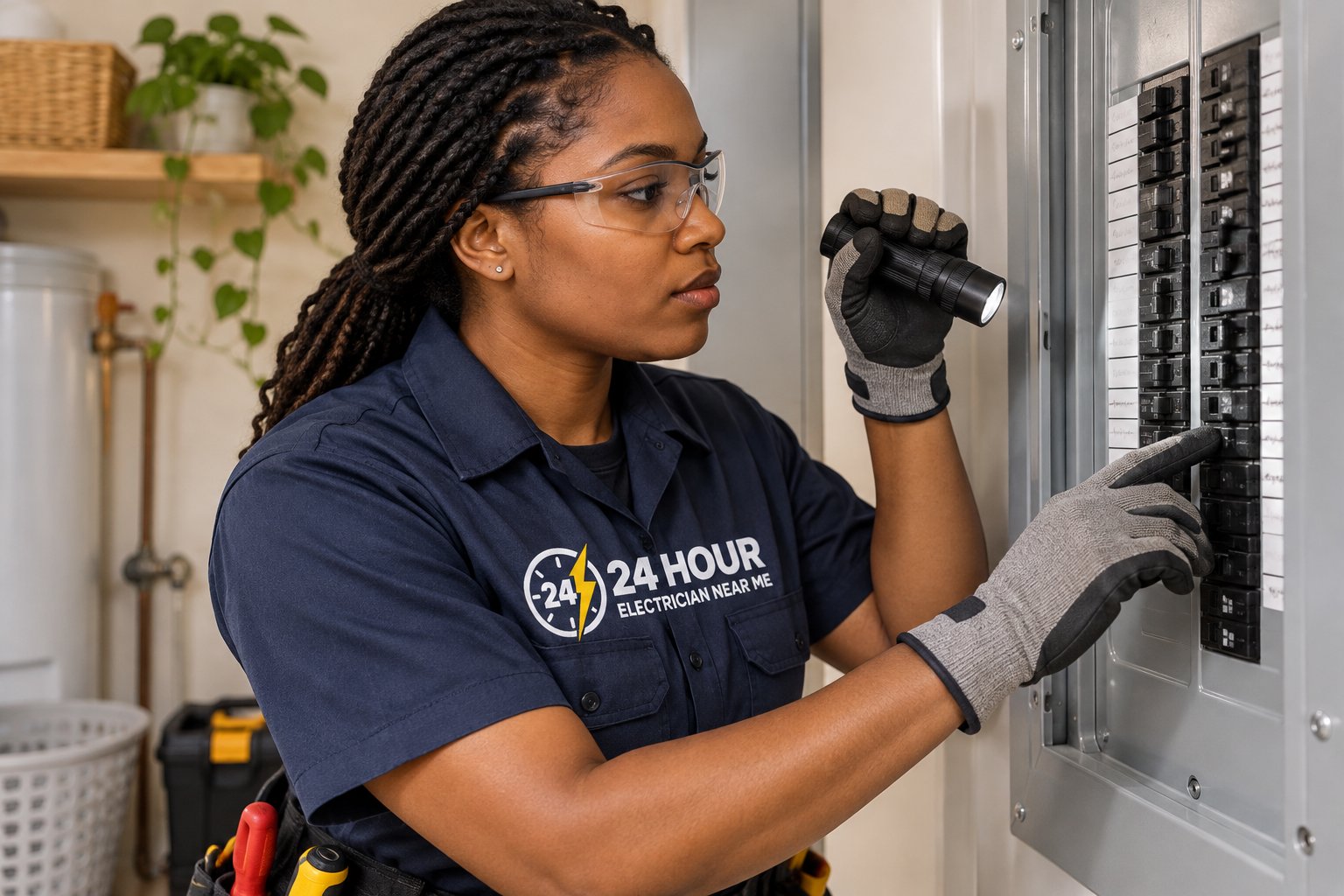
What a subpanel is and what it does
A subpanel is a secondary distribution panel. It does not connect to the utility directly. Instead, a heavy cable called a feeder runs from a breaker in the main panel to the subpanel, which then divides that power into its own branch circuits. You can think of it as a branch office: it handles local traffic, but it depends on the main office for its supply.
The advantage is location. Instead of running many separate circuits from the main panel across the property, one feeder goes to a convenient point and the subpanel fans out from there. A detached garage, a workshop, an accessory suite, a pool equipment pad or the far end of a large house all benefit. Shorter branch circuits are easier to install and can reduce voltage drop.
A subpanel also solves the problem of full panels. If the main panel has no spaces left, a subpanel can add new breaker positions without replacing the whole panel. This only works if the main service has spare capacity, because a subpanel does not create more power. It creates more places to connect to the power that already exists, and that distinction matters when deciding whether a subpanel is the right answer.

Situations where a subpanel makes sense
The best cases share a pattern: new loads in a location far from the main panel, and enough spare capacity at the service. A detached garage with a workshop, a freezer, lighting and a car charger is a classic example. So is a room addition on the far side of the house, or a pool pad with a pump, heater, salt system and lights.
Remodels often call for subpanels. A kitchen renovation that adds a double oven, a wine cooler and an island may exceed the available spaces. A finished garage turned into a guest suite needs its own set of circuits. Placing a subpanel near the new space keeps the wiring tidy, and it gives the occupant a local place to turn off power.
Sometimes a subpanel is not the right choice. If the main service is overloaded, adding a subpanel does not solve that, and the right answer may be a larger service. Our page on main service upgrades describes that path. If the main panel is a known problem brand or in poor condition, replacing it may be wiser than adding to it. A technician examines the panel and recommends the right path.
- Detached garages, sheds and workshops
- Room additions and accessory suites
- Pool equipment pads and outdoor kitchens
- Remodels that add several large circuits
- Panels that are full but whose service still has spare capacity
Sizing the feeder and the subpanel
Sizing starts with a load calculation. The technician lists what the subpanel will serve, adds the loads using accepted methods, and chooses a feeder breaker and cable that can carry the result. A garage with lights and a few outlets needs a modest feeder. A garage with a welder, an EV charger and a compressor needs a much larger one.
Future use also matters. Pulling a larger feeder now is often easier than replacing it later, especially if conduit is buried. A subpanel with extra spaces gives room for additions. The rule of thumb is to plan for what you are likely to add, without oversizing wildly. The technician can explain the trade-offs between a modest feeder and a larger one.
The main service has to support the feeder. If the main panel is at or near its limit, adding a large feeder may overload it. A technician checks the actual demand on the service, not just the number of breakers, and tells you whether the new load fits. If it does not, options include load management, a larger service or a reduced scope. Our page on choosing electrical service size explains how that calculation works.
| Subpanel purpose | What shapes the feeder size |
|---|---|
| Garage with lights and outlets | Modest loads, small feeder |
| Garage workshop with large tools | Motor loads and starting current |
| Garage with car charger | Continuous charging load, dedicated sizing |
| Pool pad | Pump, heater, lights and protection requirements |
| Accessory suite | Full set of household loads, possibly a kitchen |
Feeder wiring: conduit, cable and routing
The feeder is the lifeline of the subpanel, and how it is installed depends on the route. Inside a building it may be cable run through framing. Outside, between a house and a detached structure, it is usually run in conduit, buried at the depth the rules require, or mounted on the exterior. Each method has its own materials and protection requirements.
In Florida, conduit choice matters. PVC conduit resists corrosion and is common for underground runs, though it needs proper support and expansion fittings in sun. Metal conduit is used where physical protection is needed, but humidity and salt air can corrode it. Our page on conduit types in Florida explains the choices. Water intrusion is a risk for any buried run, so conduit ends are sealed and connections are made in weatherproof enclosures.
Routing deserves thought. The feeder should avoid areas where it may be damaged by digging, tree roots or future projects. Avoid running through spaces where heat or moisture is extreme. Plan the path so that it does not interfere with sprinkler lines, pool equipment and planned landscaping. Take photos before burying anything, and keep a record of where the run goes, because someone will dig there later.
Grounding and neutrals: where subpanels differ from main panels
Subpanels have an important rule that surprises many owners. In the main panel, the neutral and ground conductors are connected together, a connection called bonding. In a subpanel, they must be kept separate. The neutral bar is isolated from the metal enclosure, and a separate ground bar is bonded to the enclosure. This prevents normal current from flowing on the grounding system.
Because of this, a subpanel feeder needs four conductors for a standard 120/240 volt setup: two hot wires, a neutral and a ground. Older installations sometimes used three-wire feeders with a combined neutral and ground, which is no longer acceptable for new work. If you have an existing subpanel in a garage, a technician can check whether the neutral and ground are separated correctly.
A detached building has additional grounding requirements. It typically needs its own grounding electrode, such as a ground rod, in addition to the equipment ground that travels with the feeder. These details are invisible after installation but are central to safety. Our page on grounding and bonding explained covers the principles. Do not attempt to modify a panel's grounding yourself.
- Neutral and ground kept separate in the subpanel
- Four-conductor feeder for new work
- Grounding electrode at a detached building
- Metal enclosure bonded to the ground bar, not to the neutral bar
- Clear labeling of every breaker and the feeder source
Location, clearance and weather protection
A subpanel needs a good home. The rules require working space in front of the panel so that a person can safely reach and operate breakers, and the space must stay clear. A panel in a closet filled with storage, behind a water heater or in a tight cabinet is a problem. Doorways, shelves and shop benches must not block access.
Location should also be dry. In a garage, the panel must be protected from damage by vehicles and from water. Outdoors, it needs a weatherproof enclosure rated for the location, mounted at the right height with sealed entry points. In South Florida, direct rain, sprinkler spray, humidity and salt air all attack outdoor equipment. A corrosion-resistant enclosure and proper sealing extend its life.
Think about how the subpanel will be used. A shutoff in a workshop is useful in an emergency, and a labeled panel in a guest suite lets occupants reset a tripped breaker without going to the main house. Place the panel where it is accessible but not in the way. A technician will mark the best location after considering the route of the feeder and the layout of the space.
Breakers, protection and what goes inside
The subpanel's breakers must be compatible with the panel's brand and type. Mixing breakers from different manufacturers can cause poor connections and is generally not allowed unless the panel is listed for it. Using the right breaker for each circuit, with the right size wire, is part of a careful installation.
Protection depends on location and use. Garages and outdoor locations typically require ground-fault protection on many circuits. Bedrooms and living areas in an accessory suite usually require arc-fault protection. A technician selects the breakers or devices that meet these requirements. Our guide to GFCI or AFCI protection explains which applies where.
Leave room to grow. A subpanel with a few open spaces allows you to add circuits later without replacing the panel. Avoid doubling up circuits on tandem breakers beyond what the panel allows. The label on the panel states how many circuits it can hold. Make sure the directory inside the door lists each breaker clearly, so that anyone can find the right one in a hurry.
Permits, inspections and condominium rules
Adding a subpanel is permitted work almost everywhere in South Florida. The permit covers the feeder, the panel and any new circuits, and the building department inspects the installation, often at rough-in and again at final. A detached structure or a new feeder trench may need an inspection before the trench is backfilled.
The utility is not usually involved in a subpanel, since it connects downstream of the meter, but the main panel must have the capacity and a breaker space for the feeder. A technician checks that before work begins. If the main panel is full or unsuitable, you may need to address that first. Our guide to electrical permits in South Florida describes how permits and inspections work.
Associations and condominiums may restrict changes. In a townhouse or condo, a subpanel inside your unit may require approval, and a feeder crossing common elements will definitely need it. Check your documents. Even in a single-family home with a homeowner association, exterior changes such as a new panel on a wall may require approval. A technician can tell you what documents the association is likely to ask for.
Common problems with existing subpanels
Older subpanels often carry hidden issues. A garage panel from decades ago may have a combined neutral and ground, an undersized feeder, missing covers or corroded lugs. Do-it-yourself additions are common: extra breakers added without checking capacity, circuits spliced in the panel enclosure, or wires routed through the wrong knockouts.
Warning signs include a panel that is warm, a breaker that trips often, buzzing, rust, water marks and an odor of burning. Our page on buzzing sounds from a panel explains what a noisy panel can mean. If you see sparks, smoke or scorching, stay away, switch off the main if it is safe to do so, and call 911 if there is fire.
A technician can inspect an existing subpanel, test the feeder, check the neutral and ground separation, confirm breaker sizes and recommend repairs. Sometimes a few corrections solve the problem, and sometimes replacement is wiser. Do not remove the cover of any panel unless you are qualified, because the feeder terminals remain live even when the subpanel breaker is off.
- Neutral and ground tied together in a subpanel
- Feeder that is too small for the loads it now serves
- Missing covers, open knockouts and loose cables
- Rust, water marks or corrosion inside the enclosure
- Breakers of mixed brands or doubled-up where they should not be
Three example scenarios
Picture a block home in Pembroke Pines with a one-car garage that the owner is turning into a home gym and office. The garage currently has a single lighting circuit and two outlets. A subpanel on the garage wall, fed by a short run from the main panel on the other side of the wall, gives the new space its own air conditioning circuit, outlets for equipment and a light circuit, without crowding the main panel.
Now consider a detached workshop behind a house in Davie. The structure is thirty or forty feet from the house, so the feeder runs underground in conduit. The technician plans for the trench, the grounding rod at the workshop and a panel with spare spaces for a future compressor. The owner decides in advance what to leave room for, so the feeder is sized with that future in mind.
Finally, think of a pool pad in Davie with an aging equipment area. The owner wants a new pump, a heater and a better lighting transformer. A subpanel at the pad, in a weatherproof enclosure with ground-fault protection, gives each piece its own breaker and a local disconnect. Our page on pool and spa electrical wiring explains the extra protection pools need. In each case, the subpanel organizes a growing set of loads close to where they are used.
Planning the project and next steps
Start by thinking about what the subpanel will serve now and in the future. List the loads: lights, outlets, tools, a car charger, a pool pump, an air conditioner. Note where the main panel is, where the new panel would go and what lies between them. A sketch or photos of the route help.
Expect an on-site visit. A subpanel project involves load calculations, routing, trenching or fishing cable, and a look at the main panel. The service call charge for the visit is explained on the phone before dispatch. Quotes are given only by phone, once the technician understands the property.
When you are ready, call and describe the project. Say what you plan to power, how far the new location is from the main panel and whether the main panel has spare space. The technician will explain whether a subpanel is the right approach or whether another path makes more sense.
Questions people ask
Does a subpanel give me more power?
No. A subpanel adds more places to connect circuits, but the power still comes through the main service. If the main service is already near its limit, adding a subpanel will not fix that. A technician checks the actual demand on the service before recommending one.
Why must neutral and ground be separate in a subpanel?
In a subpanel, keeping them separate prevents normal operating current from flowing on the grounding system and metal parts. The two are bonded together only at the main panel. This is why new feeders carry four conductors, and why older three-wire feeders should be reviewed by a technician.
Can I add a subpanel to a detached garage?
Yes, in most cases. The feeder runs in conduit, usually buried, and the garage needs its own grounding electrode. Permits and inspections apply, and the trench is often inspected before it is covered. The size of the feeder depends on what you plan to run in the garage.
Do I need a permit for a subpanel?
Yes, in nearly all South Florida jurisdictions. The permit covers the feeder, panel and new circuits, with inspections by the local building department. Skipping it can cause insurance and resale problems and leaves the work unchecked. Your electrician should handle the permit and tell you what inspections to expect.
Where should a subpanel be placed?
In a dry, accessible spot with clear working space in front and protection from vehicles and water. Closets full of storage and spaces behind equipment are poor choices. Outdoors, it needs a weatherproof, corrosion-resistant enclosure. A technician marks the best spot after considering the feeder route.
How do I get a quote for a subpanel?
Quotes are given only by phone. A subpanel project usually starts with an on-site visit to see the main panel, the route and the loads. There is a service call charge for that visit, and it is explained on the phone before dispatch, so you know it ahead of time.
Dealing with "Adding a Subpanel to Your Property"? Tell us where in the building it happens and what changed before it started. We will say what the electrician would check and how the visit charge is explained.
Related pages
- Service Upgrade: When a home outgrows its electrical capacity: replacing the service entrance, meter base and main disconnect, how the utility fits in, and what to expect.
- Garage Upgrades: Workshop power, freezer circuits, lighting and subpanel options for attached and detached garages, with notes on moisture, heat and safe planning.
- Panel Repair: Guide to electrical panel repair, replacement and capacity upgrades in South Florida: what an evaluation covers, permits and what to prepare before a visit.
- Dedicated Circuit Installation: South Florida dedicated-circuit planning for residential and commercial appliances, equipment, renovations and electrification.
- Grounding and Bonding: What grounding electrodes, bonding jumpers and equipment grounds each do, why many older Florida homes lack them, and how a technician checks yours.
- Whole-Home & Commercial: A practical guide to layered residential and commercial surge protection in Broward County and the cities from Boca Raton to North Miami.