

Three kinds of electrical customers in one city
Sunrise is home to several age-restricted and adult communities, many of which were built a few decades ago and still have a high share of original construction. It also has townhome and single-family neighborhoods, and a strong commercial base that includes large shopping centers, restaurants, offices and service businesses. A technician who works in Sunrise will see all three in the same week, and the right approach is different for each.
For retirees, the priorities are clarity, safety and a calm process. Many residents have lived in the same home for years and are not eager to have a stranger in the house. They want to know who is coming, what will be done, how long it will take and what it will involve, and they want to be sure they are not being pushed into work they do not need. That is a fair expectation, and any good electrical company should meet it.
For townhome owners, the main issue is understanding what belongs to whom. For shopping plazas, the issues are tenant coordination, business hours and large equipment. This page never gives prices. Quotes are given by phone, and complicated jobs need an on-site visit, with a service call charge explained on the phone before anyone is dispatched. There is no pressure to agree to anything on the spot.
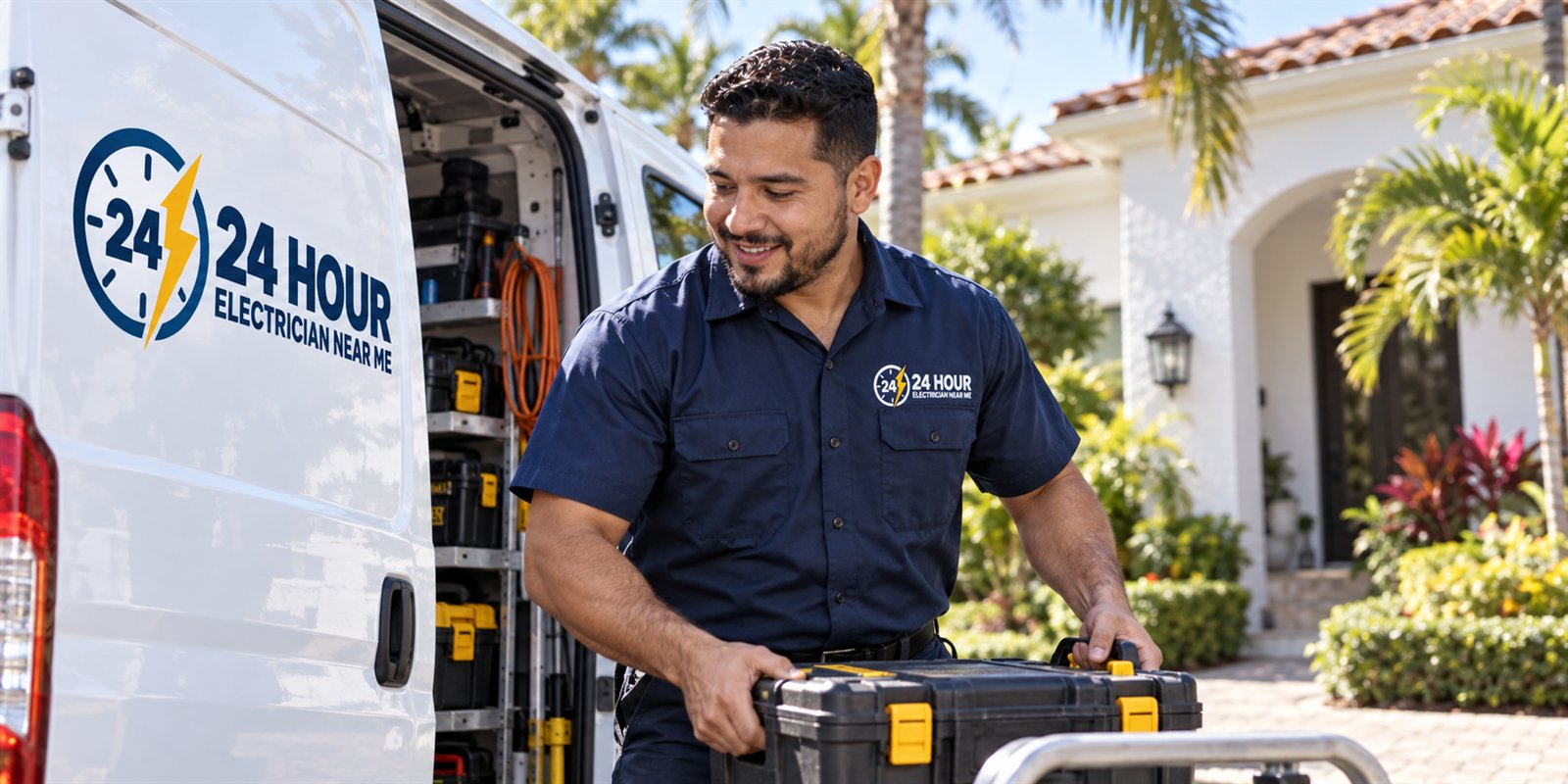
Age-restricted communities: what residents commonly ask about
In a community built for older adults, the homes tend to be one-story villas, patio homes or low-rise condominium buildings. The electrical calls are usually familiar ones: a breaker that will not stay on, outlets that no longer work, lights that flicker, ceiling fans that wobble, bathroom fans that make noise, smoke alarms that chirp and a garage door opener that has stopped. Some calls are about making a home safer and more comfortable: more light in hallways, outlets where they are easy to reach, switches that are easy to operate, night lights and better lighting in baths and kitchens.
Safety upgrades matter for aging in place. Ground-fault protection in baths, kitchens and outdoors protects against shock. Smoke and carbon monoxide alarms, interconnected so that all sound together, give early warning, and they should be tested and replaced on the manufacturer's schedule. Good lighting reduces falls. Our page on smoke and CO detector wiring explains alarm wiring, and the page on lighting installation and repair covers fixtures and switches.
Because many residents are on fixed schedules and may have mobility limits, it helps to make the visit easy. Arrange for someone to be present if you wish, such as a relative or a neighbor. Have the area clear. Tell the technician about any concerns, including pets, oxygen equipment or other medical devices that depend on power. If a loss of power would be dangerous for you, ask the technician about backup options and about registering with the utility for medical needs, and keep emergency numbers handy.
- Ask who is coming and what they will do before they arrive.
- You are never obliged to agree to work on the spot. Ask for the scope in writing if you want it.
- Keep a list of what is plugged in near medical equipment.
- If a power loss would be dangerous, talk to your doctor and the utility about a plan.
Community rules, boards and approvals
Most age-restricted communities have a board or a management company with rules on contractors and on changes to the exterior. In a villa or patio home, the association may control what you can install outside, such as lights, outlets, generator inlets or chargers, and may also require contractors to carry insurance and check in at a gate. In a condominium building, the association usually controls the common electrical equipment, and the unit owner controls the wiring inside the unit.
If a problem seems to affect more than your own unit, such as hallway lights out, several neighbors without power or a noise from a common electrical room, call the property manager first. If your own outlets, breakers or fixtures are the problem, you can usually call an electrician directly, but give the management office a courtesy notice so the gate and the elevators are ready. Our guide on condo electrical responsibility explains the usual split.
Some communities restrict work hours, and some limit work on weekends. Ask about quiet hours before scheduling. Some need a certificate of insurance on file, and some need a signed form for any work that involves opening a wall or shutting off a shared circuit. Do not skip these steps. They protect you and your neighbors, and a technician who understands association rules can help you meet them.
Townhomes: shared walls, shared risks
Townhomes in Sunrise often share walls with neighbors, and sometimes share a meter bank or service equipment arrangement. The wires in the shared wall may serve both units. A problem that looks like it is in your unit can start next door or in common equipment. Because of that, a technician has to be careful about what can be tested and changed.
Typical townhome calls include a panel that is full, a breaker that trips with new appliances, outdoor lights that stop working, a garage outlet that is dead, an electric vehicle charger request, and a loss of power in part of the unit. If both you and your neighbor have lost power, the cause may be common, and the management company or utility may need to be called. If only you have lost it, the problem is probably within your service.
For EV chargers in townhomes, the usual obstacles are association approval, the location of the panel relative to the parking spot, and the capacity of the service. Our page on EV charger installation goes through the questions. Never run a charging cord across a walkway or through a shared area without approval, since it is a trip hazard and may violate association rules.
Aging systems in communities built decades ago
Many Sunrise communities date from decades past, and the electrical systems were designed for the lifestyle of that time. A home built then may have a modest service and a panel with limited spaces. It may have fewer outlets than people use today, and may have outlets without ground-fault protection where it is now expected. Wiring behind the walls may be fine or may show wear, and the only way to know is to have it checked.
Signs that a technician should look include outlets that are warm or discolored, switches that crackle, lights that flicker or dim, a panel that buzzes, a smell of hot plastic, breakers that trip regularly, and fixtures with brittle or darkened wire at the connections. Pay attention to ceiling lights recessed in insulation, which can overheat if the wrong bulbs are used, and to old bathroom fans whose motors have worn out.
A safety inspection can document the condition of the panel, devices and visible wiring, and point out what needs attention. See our page on electrical safety inspection. It does not certify the whole house, and it cannot see inside walls, but it gives a good basis for decisions. Our guide on older Florida home wiring explains what technicians usually look for.
Large retail centers and shopping plazas
Sunrise has major shopping centers and many smaller plazas. For property managers and tenants, electrical service has its own character. A plaza has a main service and often a switchgear room, with tenant meters, tenant panels, parking lot lighting, signs, facade lighting and common-area circuits. A problem may be inside one tenant's suite, in the common area or in the service equipment. Knowing which is the first step toward getting it fixed.
Typical retail calls include a suite with lights out, a storefront sign that does not come on, parking lot lights that are dark, an equipment circuit that trips, emergency and exit lighting that fails its test, and a panel that has been overloaded by tenant additions. Restaurants in plazas add kitchen equipment, hoods and refrigeration. Medical and service tenants bring equipment that needs reliable power.
Work in a plaza usually has to be coordinated with the landlord and sometimes with other tenants, and it often needs to happen at night or on a slow day. The technician will ask who can authorize work and who is responsible for each part of the building. See our commercial pages on retail store electrical service, parking lot and garage lighting, sign and facade lighting and property management electrical support.
Examples from a typical week
These short scenarios illustrate how calls tend to go. They are illustrations, not records of actual jobs.
| Caller | Problem | Typical path |
|---|---|---|
| Retired homeowner in a villa | Kitchen outlets stopped working | Check for tripped ground-fault device, test circuit, repair or replace failed device |
| Condo resident | Hallway lights out and unit lights flickering | Contact property manager, check unit panel, separate unit from common issues |
| Townhome owner | Wants EV charger | Review panel, parking location, association approval and permit path |
| Plaza manager | Parking lot lights dark in one section | Check photocell, breaker, wiring and fixtures, schedule lift or access work |
| Small shop tenant | Sign does not light | Test timer, circuit, transformer or driver, confirm landlord authorization |
Power outages, medical equipment and planning ahead
For residents who rely on powered medical equipment, such as oxygen concentrators, CPAP machines, mobility chargers or refrigerated medication, an outage is more than an inconvenience. Planning ahead is sensible. Talk with your medical provider about a backup plan. Ask the utility whether it offers a way to identify customers with medical needs, and what that does and does not promise. Keep batteries charged, keep a list of emergency contacts and know where the nearest alternative is if you need to leave.
From the electrical side, there are a few practical points. A portable generator must be used outdoors only, away from windows and doors, and never indoors or in a garage, because exhaust contains carbon monoxide. In a condominium or a community with rules, generators may not be allowed at all, so ask first. A small battery backup unit for a specific device may be a better fit than a generator for many residents. A technician can talk through options but cannot promise that any system will keep power on during every kind of event.
It also helps to know how to reach your main breaker, and to keep a flashlight near it. After a storm, do not touch flooded outlets, and do not turn on equipment that was wet. Our guide on power outage preparedness offers a checklist, and the guide on FPL outage versus your own electrical problem helps you decide whether the cause is the utility or your property.
Whole-home battery systems and standby generators are larger projects with permits and planning. They are not required for most households, and no one should pressure you to buy one.
Scam awareness and choosing who comes to the door
Older homeowners are sometimes targeted by door-to-door sales and high-pressure repair offers. Take a moment to protect yourself. A reputable electrical contractor does not show up uninvited to tell you your wiring is dangerous. If someone does, do not let them in, and do not agree to anything. Ask for the company name, the contractor information and a written description. Check credentials with the state yourself. Take your time.
For any work, ask what will be done, why, who is doing it and how the price is set. Prices should come from a conversation or a site visit, and you should be able to say no. A good company explains its service call charge up front, tells you if a permit is needed and gives you time to decide. Our guides on what to ask before hiring an electrician and how to compare electrical quotes can help you think it through.
You may also want a trusted relative or friend to be present during any visit, or on the phone. That is perfectly reasonable, and a technician should welcome it.
Permits, inspections and paperwork
Electrical work beyond simple device replacement in Sunrise generally needs a permit, with inspections before the work is closed out. That applies to panel changes, new circuits, service upgrades, generator hookups and many commercial alterations. The contractor normally handles it, and you should ask who will. Keep the final inspection record, since it can be useful when selling the home or dealing with an insurance company.
In communities with boards, approvals may be needed in addition to a municipal permit. In commercial plazas, the landlord's approval and the building's rules on contractors typically apply. Our guide on electrical permits in South Florida gives a general overview. We do not list fees or processing times here, because those change and the building office is the best source.
Preparing for the call and the visit
When you call, you will be asked where you are, what is happening and whether anyone is in danger. If there is fire, smoke or someone injured, call 911 first. For other problems, describe what you see and when it started. A technician can often tell by phone whether a problem can wait and what to do meanwhile.
Simple jobs can be quoted on the phone. Complicated jobs need a visit, with a service call charge explained before dispatch. No arrival time is promised, and the word 24-hour in the site name describes a service idea and not a promise of a technician at every hour and place. If you need a particular time of day, say so, and the office will tell you what is possible.
For residents, have the address, community name, gate instructions and a contact person. For a plaza, have the suite number, the landlord or manager contact and the name of the person who can approve work. If something in your Sunrise home or business is not working right, call and describe the situation.
Questions people ask
Can a family member be present during the visit?
Yes, and many residents prefer it. A relative or neighbor can be at the home or on the phone. Tell the office when you book, and tell the technician at the door. A clear explanation of the problem, the options and the next steps should be given to you directly, with time to ask questions.
A stranger knocked and said my wiring is dangerous. What should I do?
Do not let them in and do not agree to any work. Reputable contractors do not usually go door to door with warnings. Ask for the company name and credentials, and verify them yourself with the state. If you are worried about your wiring, call a company you chose and ask for an inspection.
Who fixes hallway lights in my condo building?
Common-area lighting usually belongs to the association, so call the property manager. Your own unit's wiring and fixtures are normally yours. If both are affected, the manager can help work out the cause. Do not open electrical rooms. A technician can work on your unit once the common side is clear.
Do townhomes share electrical problems with neighbors?
Sometimes. Townhomes share walls and may share a meter bank or service arrangement. If you and a neighbor both lost power, the cause may be common equipment, and the manager or utility should be told. If only you lost it, the problem is probably within your own service.
Do you give prices on this page?
No. Quotes are given only by phone. Simple jobs can be quoted on the call. Complicated jobs need a technician to see the property, and a service call charge applies to that visit. It is explained on the phone before dispatch. You are never obliged to agree on the spot.
My smoke alarm chirps even with a new battery. Why?
The alarm may be at the end of its service life, may have a wiring or interconnect fault, or may be reacting to dust or humidity. Alarms have a replacement date printed on the back. A technician can test the circuit and replace or rewire alarms so that they sound together, which is safer than silencing the chirp.
Dealing with "Sunrise Electrical Service Guide"? Tell us where in the building it happens and what changed before it started. We will say what the electrician would check and how the visit charge is explained.
Related pages
- Smoke and CO Wiring: How hardwired, interconnected smoke and carbon monoxide alarms are wired, why battery backup matters, and what changes in a sale or remodel.
- Condo Responsibility: Where a condo unit owner's electrical responsibility ends and the association's begins, from the unit panel to risers, meters and common equipment.
- Retail Stores: Electrical help for retail stores: display lighting, point-of-sale power, signage circuits and storefront outages in shopping-center settings.
- Questions to Ask: Questions about credentials, permits, insurance and process that protect you before you let an electrician work on your Florida property.
- Plantation: Electrical help in Plantation, Florida: mid-century ranch homes with aging panels and wiring, renovated lots and office parks along University Drive.
- Tamarac: Electrical help in Tamarac, FL: older condos, villas and townhomes, shared meter banks and association rules. What to know and have ready before you call.