

Two owners, one line down the middle
Electric service has a natural dividing line. On one side is the utility: the poles or underground cables, the transformer serving your street, the wires that run to your building and, in most cases, the electric meter itself. On the other side is the property owner: the meter socket or its equivalent, the main disconnect, the panel, every breaker, all wiring in the walls and every outlet, switch and fixture.
That division matters because each owner repairs only their own side. A utility crew will not fix a failed breaker inside your panel, and an electrician will not touch the utility's transformer or the wires up to the weatherhead. When the lights go out, the quickest way to get help from the right party is to work out which side of the line the fault is on.
In practice the picture is a little more detailed, and our page on who owns what at the electric meter walks through the boundary in plain language. For this guide, the key idea is simple: a widespread outage points to the utility, while a partial or isolated loss of power points to your side.
Start with your own eyes and your neighbors
The first check costs nothing and takes a minute. Look outside. Are neighbors' windows lit? Are streetlights on? Is the traffic signal at the corner working? If the whole street is dark, a utility-side cause is likely, and the sensible move is to report the outage to the utility through its outage line or app, and to avoid doing anything to your own panel.
If neighbors have power and you do not, the cause is more likely on your side of the meter, or on the service wires that serve only your property. Our page on what to do when neighbors have power and you do not expands on this situation.
Be careful with assumptions. Some neighbors may be on a different transformer or a different phase, so a neighbor with power does not always mean your equipment is at fault. In a building with multiple units, ask whether other units on your floor or stack are affected, and whether the common-area lights are working, because that points to a building-level cause that the manager must handle.
Safe checks you can do at the panel
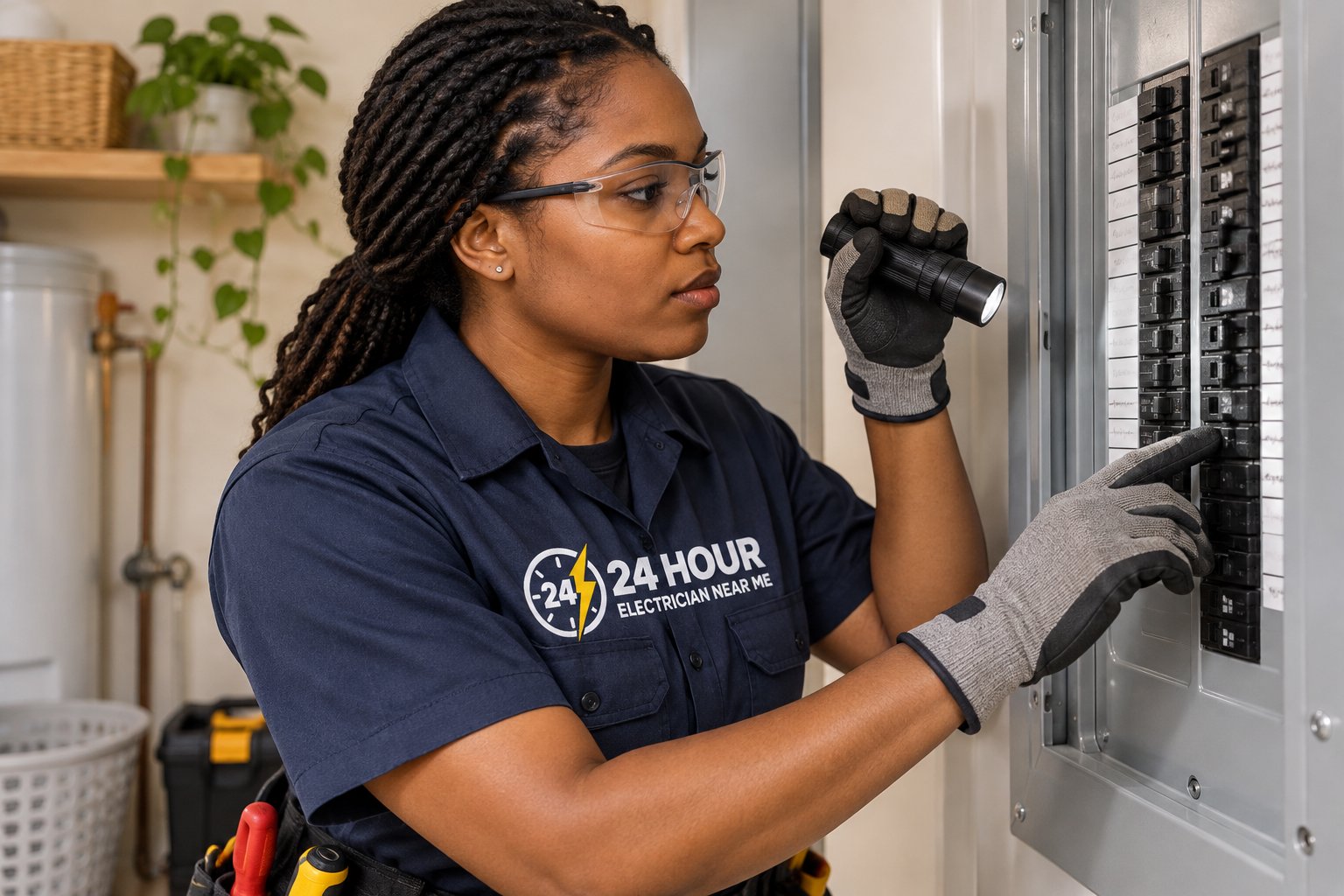
If the cause appears to be on your side, there are a few safe checks. Go to the panel without standing in water and with dry hands. Look at the main breaker, usually the largest at the top. If it has tripped to the middle or off position, that alone does not prove a fault, since a power surge or a heavy load can trip it. Reset it once by switching it fully off and then on. If it trips again immediately, stop.
Check whether any branch breakers are in the middle position. A tripped breaker shows a handle between on and off. To reset, push it fully to off and then to on. If a breaker trips again right away or will not stay on, that is a sign of an overload or a fault that needs attention. Our guide on what to do when a breaker will not reset explains what that means.
Do not remove the panel cover, probe wires or use anything metal near the panel. If you see scorch marks, melted plastic, water inside or smell burning, leave the panel alone, move away and call. If there is smoke or fire, call 911 first.
- Look outside at neighbors, streetlights and signals
- Check the main breaker and any breaker in the middle position
- Reset a tripped breaker once, fully off then on
- Never open the panel cover or touch wiring
- Smoke, burning smell, sparks or water at the panel: step away and call
Reading the pattern of what is out
What exactly has lost power tells a lot. A total blackout in the property with the main breaker still on points toward the utility or to the service wires and meter. A partial loss, such as half the lights and outlets, points toward the property's own wiring, since many homes have two energized legs and one can fail on its own. Our page on half the house with no power explains how that happens.
If only one room or one circuit is out, the cause is nearly always inside the home: a tripped breaker, a failed ground fault outlet, a loose connection or a damaged device. Check any ground fault outlets in bathrooms, kitchens, garages and outdoors for a tripped button. Our guide on why only one room has no power goes into more detail.
Another clue is whether lights are dim, bright or flickering. Voltage that swings or drops across several rooms can indicate a loose connection at the meter or on the service wires. Because those parts straddle the dividing line, they can involve both the utility and an electrician, and should be left to professionals.
Signs that point to the utility side
Several clues point toward the utility. An outage that covers a block or more, a popping sound or flash seen near a pole or transformer, a visible downed line, and a sudden loss of power during a storm are all consistent with a utility-side fault. Outages tied to vehicle crashes, tree limbs on lines or flooding of equipment in the street are also the utility's to repair.
In these cases, report the outage to the utility and, if a line is down, keep everyone at a safe distance. Treat every downed line as live. Do not touch it, do not drive over it and do not assume it is harmless because it is not sparking. If a line is on a vehicle, tell the occupants to stay inside until help arrives, and call 911. Our page on a power line down at the property sets out the safety basics.
While you wait, follow your household's outage plan. Our guide on building a power outage plan covers medical devices, food, communication and backup power so that waiting is safer and less stressful.
Signs that point to your side of the meter
Signs that the problem is yours include a tripped main breaker that will not stay on, a breaker that trips repeatedly, a burning smell near the panel or an outlet, buzzing or crackling from the panel, a damaged meter box or a service mast that is bent, loose or pulled away from the building. Water inside the panel or meter socket, even without a power loss, is also an urgent property-side concern.
Another strong clue is timing. If power failed the moment you plugged in an appliance, started the air conditioner or turned on a space heater, the load or the appliance is more likely the cause. If power went out with a lightning strike nearby, the strike may have damaged equipment on either side of the meter, and both parties may need to inspect their own gear.
Damaged service equipment such as the weatherhead, mast and meter socket is a gray zone. In general, the utility handles its wires and the meter, and the owner handles the mast, the socket and everything after. Our pages on service mast and weatherhead repair and a damaged or hanging meter box explain what that repair usually involves.
When both parties have to work in order
Some situations need both a repair and an inspection before power can return. If a storm damages the mast, the utility typically needs the owner's equipment to be repaired and in some areas inspected by the local permit office before the wires are reconnected. That means the order of work matters: the owner arranges the electrician, the electrician repairs the equipment, any required inspection is passed and then the utility restores service.
These steps vary by city and county, and the rules are set by the permitting authority and the utility, not by the electrician. A qualified electrician can tell you what is required for your location and whether a permit is needed. Our page on electrical permits in South Florida explains the general process.
Because the sequence involves several parties, calls early help. When you phone, say that the utility has disconnected or that you suspect a service-side fault. That lets the dispatcher decide whether a site visit is needed. Quotes are given by phone, and a service call charge applies and is explained before dispatch.
What not to do while waiting
A few habits make outages more dangerous. Do not run a portable generator indoors or connect it to a wall outlet. Do not use charcoal grills or camp stoves inside. Do not reset breakers repeatedly or tape a breaker in the on position. Do not enter flooded rooms with the power on, and do not touch fallen lines or anything in contact with them.
It is also unwise to turn on every switch to see if the power is back. Instead, switch off big loads such as the air conditioner, water heater, range and clothes dryer, leave one light on, and wait a few minutes after restoration before bringing those loads back one at a time. This reduces stress on equipment and avoids tripping the main breaker when everything restarts at once.
If your area is subject to frequent flickers and surges, whole-home or point-of-use surge protection is worth discussing. Our guide on whole-home or point-of-use surge protection explains how the layers differ.
What to tell us when you call
Having a few facts ready makes the call more useful. Say whether neighbors have power, whether the main breaker is on, whether any breaker is tripped and whether it resets, and whether you smell burning or see scorch marks. Mention any recent storm, lightning, flooding, renovation or new appliance. Tell us whether the building is a house, condo or apartment, and whether the utility has already been contacted.
From those facts, we can often tell you over the phone whether the likely cause is on the utility side, in which case the best step is to report it to the utility, or on your side, in which case a technician may be needed. If the situation could be dangerous, we will tell you to move away from the equipment and, if necessary, call 911.
You do not need to know the technical names for everything. Plain descriptions such as half the lights are out, the panel is buzzing or the breaker keeps clicking back off are enough. When in doubt, call and describe what you see. We would rather answer a short question than have someone take a risk at the panel.
Questions people ask
How can I quickly tell if the whole street is out?
Look outside at neighbors' windows, streetlights and traffic signals. If they are dark too, the cause is probably on the utility side, and you should report it through the utility's outage line or app. If neighbors have power, check your main breaker and any tripped breakers, and call if a breaker will not stay on or you notice burning smells.
Is it my problem if my main breaker tripped?
Possibly. A tripped main breaker means something drew too much current or a fault occurred on your side. Reset it once, fully off and then on. If it holds, the cause may have been a temporary overload or surge. If it trips again immediately, leave it off and call, since there may be a short circuit or damaged equipment.
Who repairs a damaged meter box or service mast?
In general, the utility owns the wires and meter, and the property owner owns the mast, meter socket and equipment after it. A damaged mast or socket usually needs an electrician, and sometimes a permit and an inspection before the utility reconnects. Local rules vary, so ask when you call and your electrician can explain the steps for your location.
Why do my lights flicker when the utility is working?
Flicker can come from a loose connection at the meter, on the service wires or inside the panel, from heavy loads such as an air conditioner starting, or from outside voltage changes. If flicker is constant, or accompanied by buzzing or burning smells, call. A technician can check connections and measure voltage to find out which side is responsible.
Should I call the utility or an electrician first?
If neighbors are out too, call the utility. If only your property is out, or you see damage to the meter box, mast or panel, or a breaker that will not reset, call an electrician. If a line is down or there is smoke, fire or sparking, call 911. When unsure, call us and describe what you see.
What is safe to do at the panel while I wait?
Look, but do not open it. Check the main and branch breakers, and reset a tripped breaker once by switching it fully off and then on. Do not remove the cover, touch wires or use tools. Do not stand in water or touch the panel with wet hands. If anything looks scorched, smells hot or buzzes, step away and call.
For "Is It a Utility Outage or Your Own Problem?", a phone call comes first. Describe the circuit, the breaker or the equipment, and we will talk through the safe next steps and whether the job needs an on-site look.
Related pages
- Outage Plan: Build a household power outage plan for South Florida: medical needs, food, communication, safe generator use and when to involve an electrician.
- Meter Responsibilities: Where utility equipment ends and the property owner's equipment begins at the electric meter, and who repairs what when something is damaged.
- My Home Only Out: When only your property is without power, the cause may be the main breaker, meter, service drop or a utility fault. Learn what to check and who handles it.
- Half the House Dark: When half of a house loses power while other lights run dim or bright, the cause is often a lost leg or loose neutral. Learn what to do and why.
- Downed Power Line: A downed power line is life-threatening. Learn how to stay clear, who to call first, and what electrician work follows on your side of the meter.
- Older Home Wiring: Wiring materials found in mid-century South Florida construction, how they age in humid conditions, and signs that an older system needs attention.
Noting the details of an outage so the right party can act
Whether the cause turns out to be on the street or inside your home, a few written notes make the next conversation easier. Record the time the lights went out, whether it happened suddenly or after flickering, and whether any storm, loud noise, or flash came first. Note what is out and what still works. Partial outages, where some rooms are dark and others are fine, tell a different story from a complete loss of power, and that distinction often helps the person you speak with. Small details noted at this stage tend to save a second trip later, so mention anything unusual even if it seems minor.
Take pictures of anything unusual that you can see safely from a distance: a scorched meter cover, a wire hanging near the house, a tree resting on the service line, or a tripped main breaker. Do not approach downed lines, and treat any wire on the ground as energized. If you can see a hazard outside, report it to the utility and emergency services rather than trying to judge it yourself. Photographs help later when explaining to a technician or an insurer what you found. Photographs taken from a safe distance are often more helpful than a long description, and they cost nothing to gather.
Finally, keep your phone charged and your information organized. Write down the account number printed on your bill, the address, and a contact number, and note whether anyone in the home relies on powered medical equipment. If the evidence points toward your own equipment, call us and describe what you recorded. The office can talk through the situation and confirm availability for your area. If it points to the utility, you will at least have clear notes when you report it. Keep any notes, labels, and paperwork in one place so the next person who looks at the system does not have to start from zero.
What happens after power returns and why a check can still matter
When the lights come back, the problem is not always over. Restoration can send surges through a home, and equipment that was stressed during the outage may show problems only after it has been running for a while. Before anything else, switch off or unplug sensitive electronics and large appliances, then bring them back one at a time rather than all at once. This staggered approach reduces strain on the system and makes it easier to notice if one device behaves badly. Labels on equipment, including brand names and model numbers, give a technician a useful head start before arriving on site.
Watch for signs that something did not recover cleanly. Lights that are unusually bright or dim, a hum from the panel, a burning smell, a breaker that will not stay on, or an outlet that feels warm all deserve attention. Air conditioners and refrigerators are common casualties because their compressors dislike repeated rapid restarts. If anything seems off, stop using the affected circuit and call a professional, and do not open the panel to investigate on your own. The goal is a clear shared understanding of the job, so that nothing about the scope comes as a surprise when work starts.
If the outage involved heavy rain, flooding, or a storm that damaged the building, ask for the electrical system to be looked at before you assume it is safe. Water inside equipment can cause trouble well after the event. A technician can check the service equipment, explain what they find, and describe the scope before any work begins. Call us to talk through what you are seeing, and the office will confirm availability. Keep notes and photographs for any claims you may need to make. Whatever you learn here, keep safety first and leave any opening of panels, boxes, or enclosures to a qualified professional.